
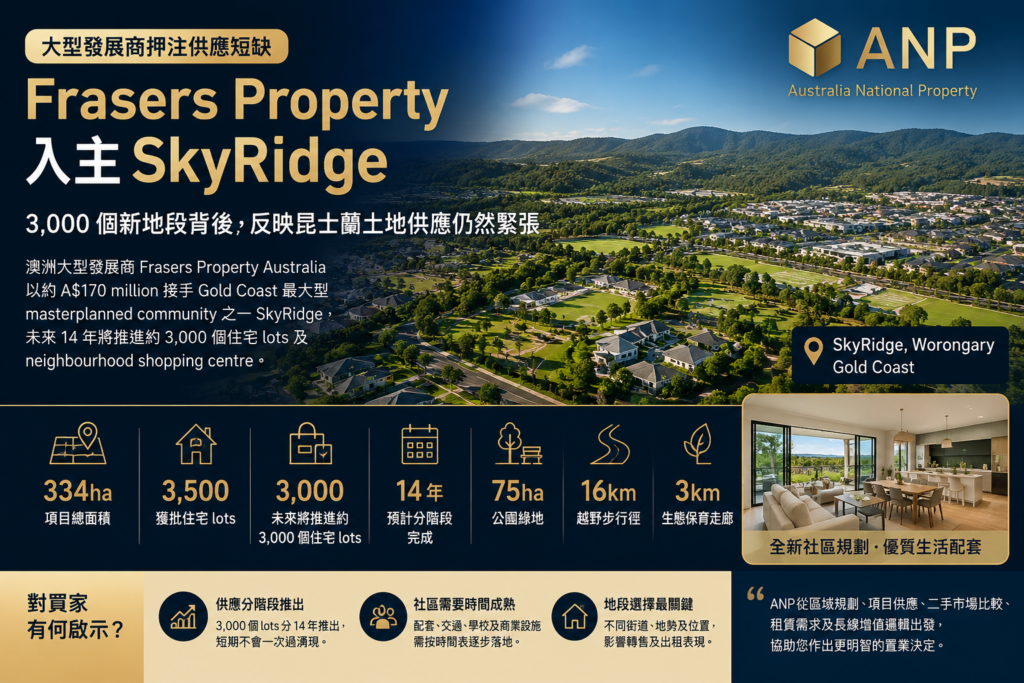
Significant developments have occurred in the Gold Coast residential land market. Frasers Property Australia, a major Australian developer, has announced the acquisition of SkyRidge, one of the Gold Coast's largest masterplanned communities, involving a land and development rights transaction of approximately A$170 million. Located in Worongary, about 7 km from Robina Town Centre and 9 km from Broadbeach, the project will develop approximately 3,000 residential lots and a neighborhood shopping centre, with phased completion expected over the next 14 years.
To the average buyer, this news simply means "thousands of new homes will be built on the Gold Coast." But from a buyer's agent's perspective, the more important question is: why would a major developer be willing to invest capital at this time to take over a large land project that still requires many years to complete?
The answer is straightforward: housing demand in the Gold Coast remains strong, while the supply of large land parcels available for immediate release is limited.
SkyRidge is not your average small housing estate; it's a large-scale community project spanning approximately 334 hectares, already approved by the Minister, and capable of developing around 3,500 residential lots. Upon completion, the entire community will include residences, community amenities, commercial facilities, parks, walking trails, and conservation corridors. The value of this type of project lies not only in "having houses to sell," but also in its ability to provide land, roads, green spaces, retail, and comprehensive community amenities all at once.
For Hong Kong buyers, this is precisely what they need to consider when analyzing emerging residential areas in Australia. Many people only look at land prices, house prices, and rental returns when buying property, but in Australia, especially in Queensland, the real factors affecting long-term value are often infrastructure, the speed of community development, and whether schools and commercial facilities can be established simultaneously.
SkyRidge is unique in that it is located in the inland hillside area of the Gold Coast, rather than in the traditional beachfront apartment market. The Gold Coast has historically been associated with high-density coastal residential areas like Surfers Paradise, Broadbeach, and Burleigh Heads; however, recent population growth, family buyer demand, and affordability pressures have led more buyers to focus on inland and transport hub areas such as Robina, Worongary, Mudgeeraba, Nerang, and Coomera.
The logic behind these types of properties differs from that of oceanfront units. Oceanfront units are typically driven by lifestyle, views, and short-term rental demand; while inland masterplanned estates are closer to the family-owned market, focusing on land size, community planning, school proximity, M1 transit, shopping centers, and daily convenience.
Frasers' acquisition of SkyRidge reflects a trend of large developers reallocating capital. Frasers recently sold several completed assets, including Eastern Creek Quarter in Sydney, Burwood Brickworks in Melbourne, and the WeAreLiving Brunswick Build-to-Rent project in Brisbane, redirecting the funds to large residential communities in the Gold Coast and Geelong. This is not a short-term speculation, but rather a strategic move to address long-term population and housing demand on Australia's east coast.
For investors, this kind of news doesn't mean they should blindly chase after any new location. Instead, it reminds buyers to distinguish three things.
First, the supply will be rolled out in phases, not all at once. While SkyRidge is a large-scale project, its 3,000 lots will be rolled out gradually over the next 14 years. The market won't suddenly have thousands more homes available in the short term, so the pressure on existing supply may not be immediately relieved.
Secondly, large communities need time to mature. The advantage of buying early is the opportunity to enter before the community matures; the risk is that some amenities, transportation, and commercial facilities may still be in the planning or construction stage. Buyers need to understand the timeline for each phase of land release, road connections, shopping centers, schools, and public facilities, rather than being attracted solely by the display home or sales center packaging.
Third, location is more important than project reputation. Even within the same masterplanned community, factors such as different streets, terrain, orientation, plot shape, slope, proximity to main roads or high-voltage power lines, etc., will affect construction costs, resale appeal, and rental performance. Buying and selling new land may seem simple, but it actually requires more preliminary analysis than buying an existing resale property.
The Gold Coast will continue to face a long-term gap between population growth and housing supply. City planning indicates that the Gold Coast may need to accommodate approximately one million people by 2046, requiring a significant increase in housing supply over the next two decades. This means that the market focus will not remain solely on coastal high-rises; more medium-density housing, townhouses, house and land packages, and masterplanned communities will expand further inland and to transportation hubs.
For Hong Kong buyers, the Gold Coast's appeal is clear: a strong lifestyle, a climate similar to Hong Kong's preferences, proximity to Brisbane, and support from universities, healthcare, tourism, and service industries. However, not every area on the Gold Coast is suitable for investment, nor is every new development worth pursuing. Some areas have a strong holiday atmosphere, but long-term rental depth is generally low; some new areas have a large supply, leading to high competition for short-term resales; some land may seem cheap, but construction costs, slope, and the time it takes for amenities to mature require careful calculation.
From ANP's perspective, while major news events like SkyRidge are worth noting, one shouldn't focus solely on the number "3,000 new lots." The real questions to ask are: When will these lots be released? Are the target buyers families, owner-occupiers, or investors? Are there already established neighborhoods nearby? Is the transportation network sufficient to support a long-term influx of people? Is the price difference between existing homes in the same area and other new developments reasonable?
For buyers looking to purchase property in Queensland, this SkyRidge transaction once again proves one point: the residential market in Southeast Queensland is still driven by population, land supply, infrastructure, and the capital deployment of large developers. When buying property, one should not only ask "where is the cheapest," but rather "where supply, demand, and amenities are developing in tandem."
ANP can help buyers determine whether a property is truly suitable for owner-occupancy or investment by considering factors such as regional planning, project supply, comparison of the secondary market, rental demand, and long-term appreciation potential. For Hong Kong and overseas buyers, conducting independent analysis before placing a deposit is often more important than trying to remedy the situation afterward.






 Chinese