
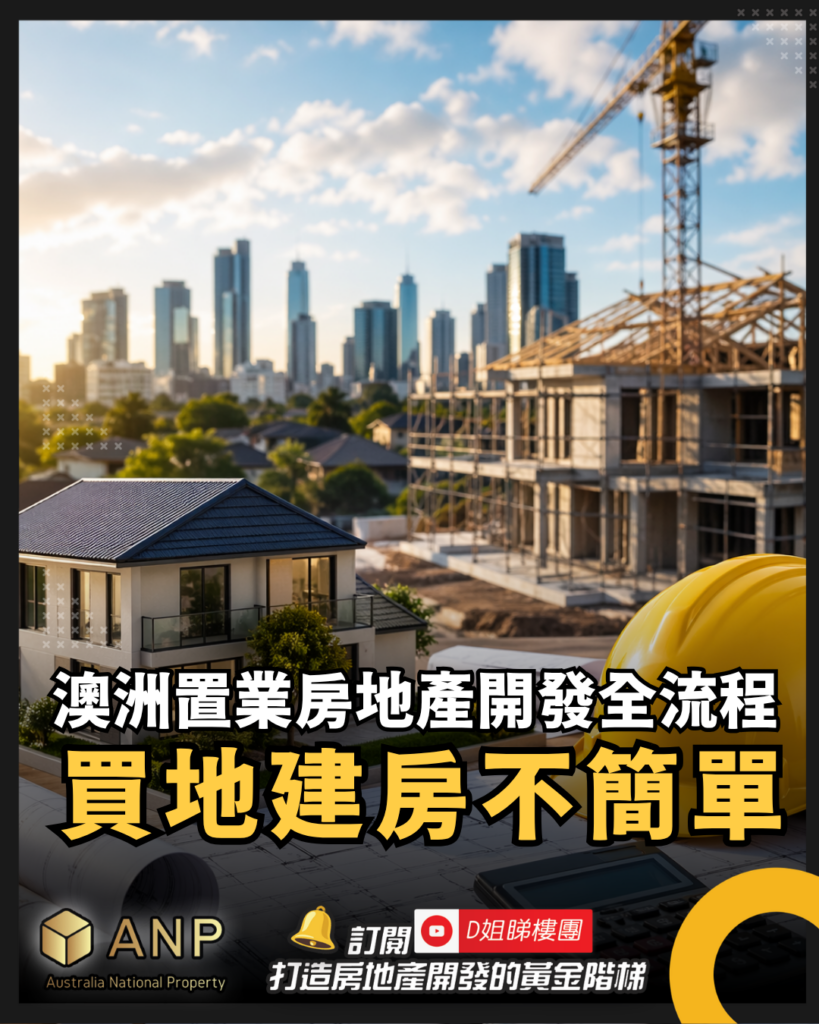
For many people looking to buy property in Australia, the first thought is often to purchase a property for rental income, expect its value to appreciate, or buy land for long-term holding. However, for some investors who want to increase returns and actively create value,Property Development It's another path worth exploring.
Contents Overview
ToggleProperty development is not simply about "buying land and building," but a complete process encompassing site selection, analysis, application, financing, construction, and ultimately, sale or ownership. This involves funding arrangements, government approvals, construction costs, market assessment, and time management. Deviations in any of these stages can directly impact project profits or even render the entire plan unfeasible.
For beginners, the most important thing is not to rush into the market, but to first understand the overall framework. Only by understanding the process, risks, and key decision-making points can one have a chance to go further and more steadily in the Australian property market.
Why are more and more people paying attention to Australian property development?
In recent years, major Australian cities have faced persistent challenges such as housing shortages, population growth, rising construction costs, and regional planning adjustments. For investors, this means the market is no longer simply relying on natural property price appreciation, but rather on proactively increasing land value through planning and development.
Compared to traditional property investment, the biggest attraction of property development lies in its ability to create additional profit margins through land rezoning, increasing buildable area, and improving product positioning. Simply put, buying existing properties mostly involves buying value already present in the market; development, on the other hand, uses professional judgment and execution capabilities to create value that was not fully realized before.
However, higher potential returns usually mean higher risks. Therefore, understanding the entire process is the first step for every beginner.
What is Property Development?
Property development can generally be understood as the process of increasing the market value of a piece of land or a property through planning, reconstruction, subdivision, additions, or changes in use.
Common forms include:
- Dividing a large plot of land into two or more residential plots
- Building duplexes, townhouses, or apartments
- Demolish and rebuild the old house
- Transforming inefficiently used land into high-value projects
- Enhancing land development potential through application approval
Property development isn't solely the domain of large developers. In fact, in the Australian market, many small and medium-sized investors start with smaller projects, such as subdividing a property into two, adding a granny flat to the backyard, or developing a duplex on a single lot. For beginners, the ideal approach is usually not to tackle large projects right away, but rather to start with projects that are simpler in structure and have more manageable risks.
Step 1: Choosing the right land is more important than anything else.
In property development, many people say one thing:Profits are often determined at the moment of purchase. This statement is not an exaggeration. Whether a piece of land is worth developing depends not only on the purchase price, but also on whether it has the potential for development.
Location determines fundamental value
Location is always the core factor. Land close to transportation, schools, commercial areas, medical facilities, and employment centers is generally more likely to attract market demand. Even with ideal planning conditions, insufficient regional demand may ultimately lead to slow sales or lower-than-expected prices.
Planning zoning affects the upper limit of development
Before buying land, you must carefully review the zoning. Zoning directly determines the land's permitted uses, building density, building height restrictions, and whether multi-family residences are allowed. Many beginners only consider the size of the land, neglecting planning restrictions, and ultimately find that their original plans cannot be realized.
Topography and actual conditions cannot be ignored
Besides planning documents, the physical conditions of the land itself are also very important, for example:
- Is there a slope?
- Is it located in the flood zone?
- Is there an easement?
- Are entrances and exits restricted?
- Are the soil conditions complex?
- Is it convenient to connect to the service facilities?
Land that appears cheap on the surface often hides hidden costs and risks. If the basic conditions are poor, even if the land price is attractive, the actual construction cost can be significantly higher.
Step 2: Feasibility analysis determines whether the project can be established.
Once a seemingly suitable piece of land has been found, the next step is not to immediately make an offer, but rather to first... Feasibility StudyThis is one of the most critical judgment tools in the entire development process.
The purpose of a feasibility analysis is to estimate whether there will still be sufficient profit, cash flow, and risk buffer after the project is completed. It is not simply a matter of subtracting the purchase price from the selling price, but rather a comprehensive consideration of the entire project's cost structure.
Common costs include:
- Land purchase cost
- Stamp duty and transaction fees
- Design, consulting and measurement fees
- DA/Planning Application Related Costs
- Construction costs
- Interest and financing costs
- holding cost
- Sales and marketing expenses
- Tax impact
- Contingency Funds and Unforeseen Expenditures
Why is this step the most common mistake for beginners?
Many people overestimate the final selling price, underestimate construction and holding costs, or ignore the impact of time delays. In reality, many projects in Australia ultimately fail not because they "cannot be completed," but because they "don't earn enough," or even because they exceed their cost limits and become unworthy of being done.
A mature investor doesn't just ask "Can it be built?", but first asks "Is it worth building?". If the numbers don't hold true, even the most beautiful concept diagrams are meaningless.
Step 3: Planning Application and Approval Process
Once the initial feasibility is established, the planning and application phase begins. This step typically involves the assistance of professionals such as town planners, architects, surveyors, and engineers to transform the original development concept into formal documents that can be submitted.
What is DA?
A Development Application (DA) is a development application submitted to the relevant council or approval authority. Its purpose is to allow the government to review whether the project complies with local planning policies, building standards, environmental requirements, and community impact considerations.
Approval processes and requirements may vary from state to state and from council to council. Some projects are simpler and have relatively straightforward approval processes; others may involve longer processing times, more technical reports, or even comments and modification requests from neighbors.
Approval is not just an administrative procedure
Many novices believe that as long as land zoning allows, approval will usually be granted smoothly. The reality is quite different. Even if development is permitted in principle, the rationality of the design, the adequacy of setbacks, the compliance of parking arrangements, and the impact on privacy and natural light all significantly influence the approval outcome.
Therefore, an experienced team is often crucial at this stage. A good consultant doesn't just draw up diagrams for you; they know how to find a balance between regulations and market demands to improve the success rate of your application.
Step 4: How do financing arrangements affect the entire project?
Once a project begins to take shape, financing becomes another core issue. Many people assume that as long as they have a down payment, banks will be willing to lend money to support the development, but the reality is usually much more complicated than a typical residential mortgage.
What are the differences between development loans and regular mortgages?
For typical owner-occupied or investment mortgages, banks primarily consider the borrower's income, debt, and property valuation; however, for development loans, in addition to the borrower's background, they also focus on the project itself, including:
- Land valuation
- Planning progress
- Project Feasibility
- Estimated construction costs
- Pre-sale status
- Borrower or team experience
In other words, even if you have good personal finances, if the project itself is high-risk or the plan is incomplete, the bank may still be unwilling to grant you the ideal financing terms.
More funding is not always better.
Many novices rely excessively on high leverage, hoping to undertake the largest projects with the least amount of capital. However, when faced with market downturns, construction delays, or rising costs, excessive leverage can quickly amplify the pressure. A sound financing structure should simultaneously consider interest costs, cash flow security, exit timing, and the ability to withstand worst-case scenarios.
Step 5: Entering the construction phase
Once the land is acquired, the permits are approved, and financing is secured, the construction phase begins, which truly tests execution capabilities. This is often the stage where cost overruns, delays, and quality disputes are most likely to occur.
The choice of Builder is crucial.
When choosing a builder, you shouldn't just look at who offers the lowest price; you should also consider the following factors:
- Past project experience
- Company financial stability
- Are the contract terms clear?
- Is the project timeline reasonable?
- Communication skills and on-site management skills
A seemingly lower construction quote may simply be a way to push costs down later, which can then be recovered through variations. Conversely, a builder with a slightly higher quote but a clear contract and a proven track record is often a better option.
Common risks during construction
Common problems during the construction phase include:
- Building material prices rise
- Construction delay
- Weather influence
- Engineering Changes
- The on-site conditions did not meet expectations.
- Increased cash flow pressure
Therefore, development is never about simply approving projects and waiting for the harvest; it requires continuous management of project progress, cost control, and quality risks. The earlier a buffer is created, the less impact unexpected problems will have on the overall return.
Step 6: Sell, hold, or refinance?
Once the project is completed, investors will face one last major decision: should they sell, hold the property for rental income, or refinance and retain the asset?
There is no absolute standard answer to this step; the key lies in the market environment, personal financial goals, tax arrangements, and future strategies.
For Sale: Quick Recovery of Funds
If market demand is strong and the selling price is ideal, selling is the fastest way to lock in profits. This approach is suitable for investors who want to improve capital turnover efficiency and are preparing to invest in the next project.
Holding: Preserving long-term cash flow
If the completed product offers satisfactory rental returns and the region has good long-term appreciation potential, some investors may choose to hold it, transforming the development results into sustainable assets. However, before holding, it is essential to re-examine the valuation, loan structure, and cash flow health.
Refinancing: Releasing some capital
After some projects are completed, if the valuation exceeds the total cost, investors may consider refinancing to recover some of the capital and reinvest it in the next project. This approach helps with capital utilization efficiency, but it still requires careful assessment of risks and debt ratios.
Common mistakes made by beginners
In Australian property development, the most common mistake beginners make is not a lack of diligence, but rather excessive optimism.
First, it's about overestimating the project's selling price after completion. Many people estimate based on ideal scenarios, but the market changes, and buyers may not be willing to pay for your expectations.
Second, underestimate total costs. Construction, consulting, interest, holding, and administrative costs are often higher than imagined, and any omission of any of these can ultimately erode profits.
Third, the timeframe is underestimated. Approval, financing, construction, and sales—each step can take longer than expected. Extended timeframes lead to increased holding costs.
Fourth, the project was underestimated. Property development may seem like a simple matter of land and buildings, but it is actually a comprehensive test of funding, processes, decision-making, and risk control.
Conclusion: Property development is not as simple as buying land and building houses.
For many, buying property in Australia is part of their asset allocation; but for investors looking to further enhance their returns, Property Development is a more proactive and advanced strategy.
However, property development is never a game of "buying land as soon as you see it and making money as soon as you finish construction." It requires a systematic approach: first, determine if the land is suitable, then check if the figures are accurate; address planning and risks first, then discuss construction and profits. Truly mature investors are not always the fastest to rush in, but rather those who understand the entire process most clearly before entering the market.
If you're preparing to learn about Australian property development, the best starting point isn't immediately looking for projects, but rather establishing the right framework. Once you understand the complete process from land acquisition, grants, financing, construction to sales, your judgment will be more sound, whether you're working on subdivisions, townhouses, or other development models.


 Chinese