
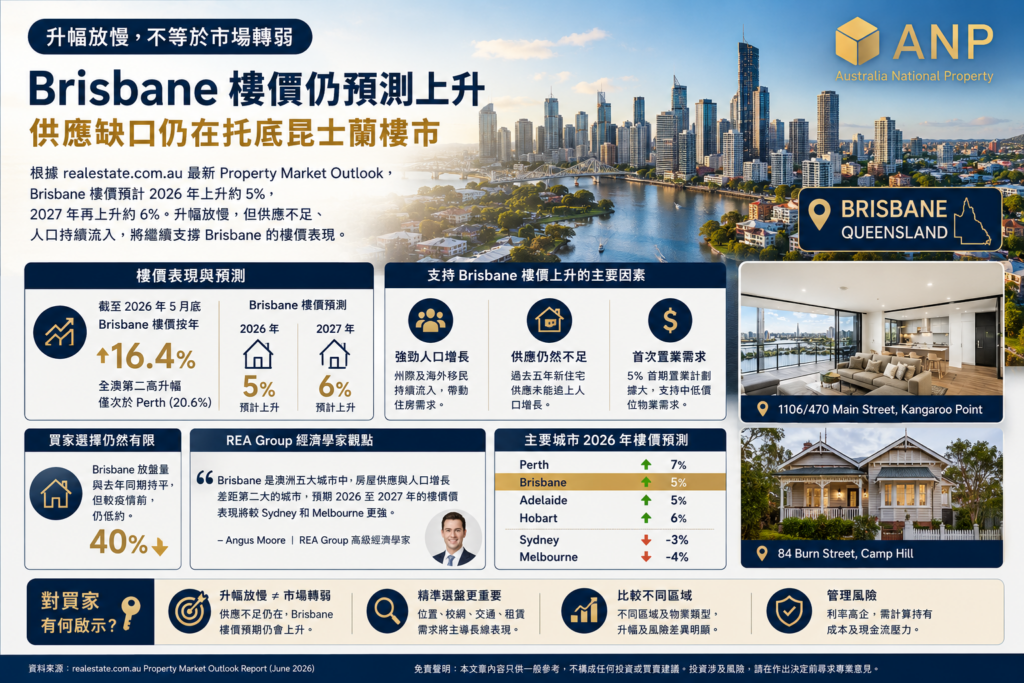
Brisbane house prices are still projected to rise.
Slower price increases do not necessarily indicate a weakening market: insufficient supply continues to support the Queensland housing market.
After several years of rapid growth, the Brisbane property market is entering a more moderate phase. According to realestate.com.au's latest Property Market Outlook, Brisbane house prices are projected to rise by approximately 51 million NT dollars in 2026 and another 61 million NT dollars in 2027. This forecast represents a significant slowdown compared to the double-digit growth of the past year, but importantly, Brisbane is not predicted to experience a decline; rather, it is transitioning from a period of rapid growth to a more moderate phase.
Contents Overview
ToggleAs of the end of May this year, Brisbane's house prices rose by 16.41 TP3T year-on-year, second only to Perth among Australia's capital cities. This reflects that Brisbane remains one of the strongest residential markets in the country over the past year. In contrast, Sydney and Melbourne have been affected by high interest rates, affordability, and weakening investor demand, resulting in a decline or stagnation in house prices. The situation in Brisbane is different; although the market has slowed, the underlying support remains clear.
The most critical factor is insufficient supply.
The report points out that new residential construction in Brisbane over the past five years has failed to keep pace with population growth, particularly the continued influx of interstate and overseas immigrants. In other words, Brisbane's problem is not simply "too many buyers," but rather that the supply of new homes has consistently failed to meet the demand gap. When there are limited property options on the market, even with rising interest rates, it is difficult for house prices to fall significantly.
Currently, Brisbane still has limited buyer options, with the number of listings roughly the same as the same period last year, but still about 401 properties per 3 listings lower than pre-pandemic levels. This figure is crucial for buyers. Many people assumed that a large number of owners would rush to sell after the interest rate hike, but in reality, Brisbane still lacks sufficient properties for sale. When supply is insufficient, properties with better quality, school zones, convenient locations, and stable rental demand remain likely to be in demand.
For buyers in Hong Kong and overseas, this market environment offers two key takeaways.
First, the strategy of "waiting for a significant drop in the housing market" should no longer be the sole approach. While high interest rates do reduce borrowing capacity and make some buyers more cautious in their offers, in Brisbane, the simultaneous existence of supply shortages and population inflows makes a widespread and sharp market decline less likely. Buyers should instead focus on comparing different areas within the same district, rather than simply waiting for the overall market to weaken.
Secondly, the slower rate of price increases actually makes buyers need to be more selective in their property selection. When the market is rising rapidly, many areas are driven by the overall market trend; however, when the rate of increase slows from 161 TP/T to 51 TP/T or 61 TP/T, the differences between different suburbs and different property types become more pronounced. Location, land size, housing condition, flood risk, school network, transportation, rental depth, and future supply will all directly affect long-term performance.
In Brisbane, for example, buyers shouldn't just look at "where it's still cheap." Some newer, outlying areas have more supply, which may lead to greater price competition in the short term; some established areas have higher prices, but land is scarce, and schools and amenities are well-developed, making them more attractive to buyers; some apartment markets have low entry barriers, but the body corporation, supply, rental targets, and resale liquidity all need careful analysis.
Another factor worth noting is the demand from first-home buyers. The report mentions that the Australian government's expanded 5% Deposit Scheme will continue to support first-home buyer demand. Such policies typically increase competition for lower- to mid-priced properties, especially townhouses, units, and entry-level houses suitable for owner-occupier families, first-home buyers, and young professionals. For investors, this means that there remains demand supporting certain price ranges.
However, buyers cannot ignore the risks. High interest rates will still affect borrowing capacity, and property price increases are no longer as rapid as in recent years. Some owners' expectations may still be at their peak, which does not necessarily mean the property is truly worth pursuing. Buyers need to calculate holding costs, rental yields, maintenance expenses, insurance, land tax, body corporate, and future resale potential, rather than simply being driven by the statement "Brisbane will continue to rise."
ANP's view is that the Brisbane market in 2026 will not be a "buy blindly and it will appreciate" market, but rather a market where "choosing the wrong area will lead to slower growth, while choosing the right property will still provide support." Slower market growth will increase the importance of professional property selection. What truly matters is not whether a particular city's average appreciation is 5% or 6%, but whether your target property is located in a location with limited supply, stable demand, mature amenities, and long-term resale appeal.
Brisbane remains a worthwhile market for Hong Kong and overseas buyers looking to purchase property in Queensland. However, before making a purchase, it's essential to conduct suburb comparisons, analyze recent transactions, assess rental demand, and review building and contract risks. A slower pace of price increases doesn't mean opportunities have disappeared; it simply means buyers need to shift from chasing rising markets to carefully selecting properties.
ANP can help buyers select Brisbane properties that are truly suitable for owner-occupancy or investment, based on factors such as regional planning, transaction data, property quality, rental demand, and long-term appreciation potential, thus avoiding decisions based solely on market news.
SEO Title: Brisbane House Prices Forecast to Rise in 2026 | Slower Growth Rates but Insufficient Supply Supports the Market
Meta Description: realestate.com.au predicts Brisbane house prices will rise by 51 TP3T in 2026 and by another 61 TP3T in 2027. ANP analyzes supply shortages, population growth, and Queensland property investment strategies from a buyer's agent perspective.
URL Slug: brisbane-property-prices-2026-slower-growth-supply-shortage
Key Keywords: Brisbane property prices, Brisbane property market 2026, Queensland property investment, Australian buyer's agent, Queensland property investment





 Chinese