
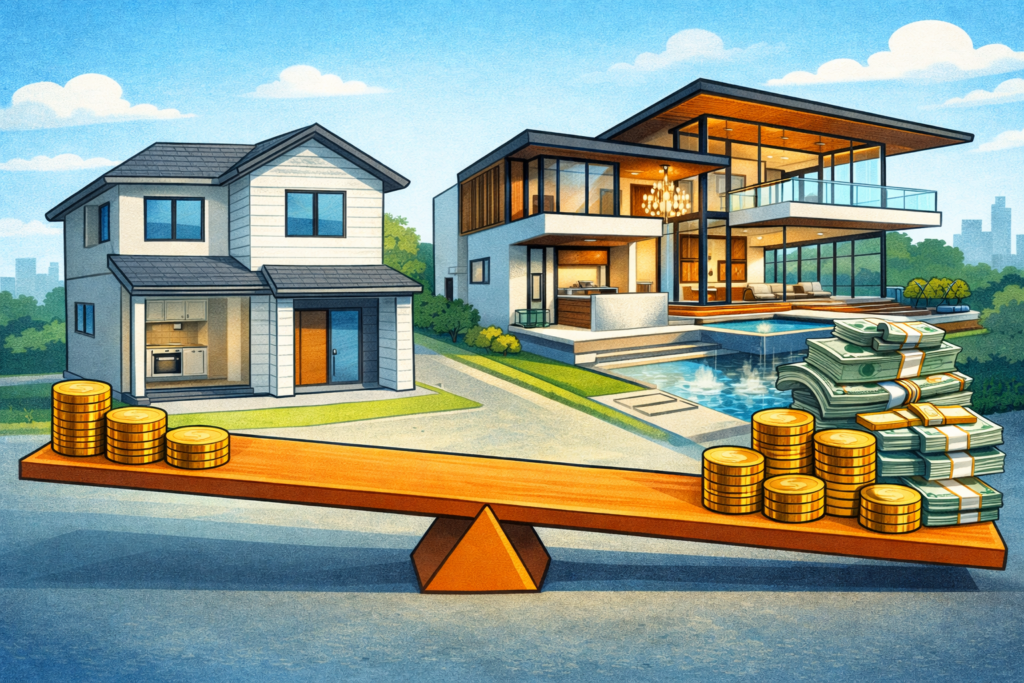
When it comes to the cost of building residential properties in Australia, many people have an intuitive question: why can two houses of similar size have such different final costs?
On the surface, the two projects appear to be similar – both are detached houses, and even their building areas are roughly the same. However, when it comes to the final bill, the total cost can be on completely different levels. This difference is not accidental, but rather caused by a combination of several core factors.
The most important element is, first and foremost, the style of the residence itself.
A typical modern home and an architectural or luxury home are fundamentally different products in terms of architectural logic. The former typically prioritizes practicality, construction efficiency, and cost control, with relatively simple design lines and more standardized shapes and structures; the latter often places greater emphasis on spatial sense, visual effects, personalized design, and overall completion. When a project transitions from "ordinary housing" to "architectural housing" or "high-end housing," the cost naturally increases significantly.
The second most influential factor is the finish level, which refers to the overall completion standard and the grade of materials used.
When initially estimating the cost of building a house, many people only look at how many rooms, bathrooms, and square meters it has, but they overlook the fact that the real differences in price often lie in the details. What kind of countertops are used in the kitchen, what kind of hardware are used in the bathroom, whether the flooring is basic or high-end, the size of the glass, the specifications of the doors and windows, whether the cabinets are custom-made, and whether the lighting design is sophisticated—all of these directly increase the construction cost.
In other words, even if the floor plans of the same house are similar, if one aspect has higher finishing requirements, the final cost can be significantly higher. This is why some houses may look similar in size, but their overall quality, construction requirements, and cost structure can be completely different.
Third, there is the complexity of the design.
This is often the most underestimated point. Many people assume that as long as the area is the same, the construction cost should be similar, but in reality, construction is never simply calculated based on area. The more complex the roof shape, the more turns, the more open spaces, the more openings, the larger the glass, and the more prominent the distinctive features, the higher the construction difficulty usually is. When the design is no longer just "building a square house," but incorporates more architectural language and form requirements, the cost will increase layer by layer, whether in terms of structure, process, materials, or labor.
Therefore, construction costs cannot be discussed in terms of area alone; they must also be considered in conjunction with how high-end, special, and sophisticated the residence is intended to be.
In fact, the most common misconception is that many people treat "area" as the sole criterion for cost. While this idea is simple in concept, it often leads to significant errors in actual home construction budgets. This is because area only indicates "how much space there is," but it does not reflect "the standards, design complexity, or completion level of these spaces during construction."
This also explains why some builders' quotes seem relatively cheap, while others are significantly more expensive. Often, the difference isn't just about the builder's pricing, but rather reflects different product positioning. Whether you're looking at a standardized residence or a custom home that emphasizes architectural aesthetics and high completion, these are inherently two different cost logics.
For those truly preparing to build a house, the most important thing isn't asking "which builder is the cheapest," but rather figuring out what kind of residence they want to build. Because different styles, materials, and design requirements will naturally result in different costs. If this isn't clear from the start, it's easy to underestimate the actual costs when budgeting later, and also to misjudge the builder's quotes.
In summary, even when building a house, the price difference can be significant. This isn't due to arbitrary market pricing, but rather because the style, finish level, and design complexity of the residence directly alter the overall cost structure of the project. A truly sophisticated home-building budget never focuses solely on size; it considers the desired level and standards, and how much resources are allocated to achieving a certain quality of life.
Therefore, when understanding construction costs, instead of just asking "how much per square meter", it's better to first ask yourself: what level do I want this house to be? Once you've figured this out, many cost differences will naturally become much more reasonable.
This article is for general informational purposes only and does not constitute legal, architectural, engineering, tax, or investment advice; individual cases require consultation with professionals based on specific circumstances.


 Chinese