
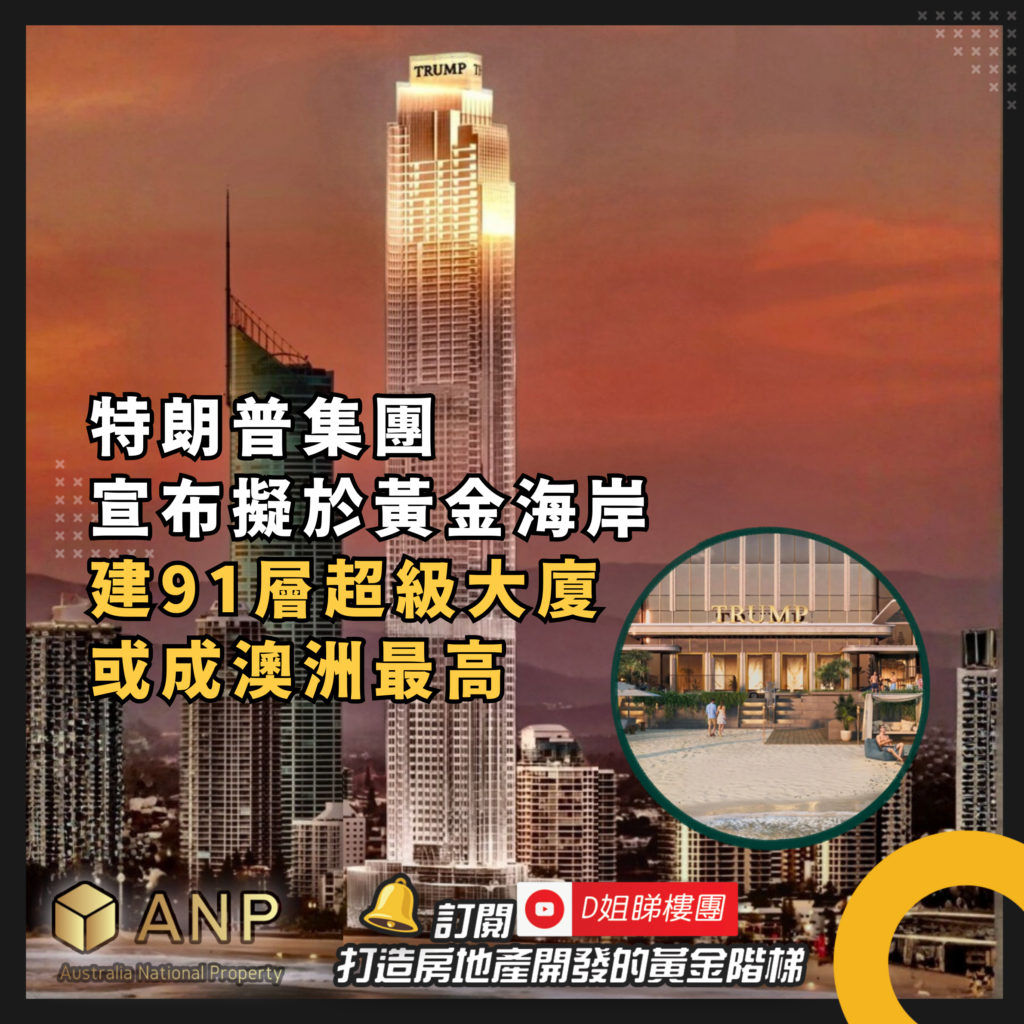
The Trump Organization, owned by the Trump family, has reportedly signed an agreement with local developer Altus Property Group to build the "Trump International Hotel & Tower Gold Coast" in Surfers Paradise on the Gold Coast. The 91-story building is estimated to be worth approximately AUD 1.5 billion.
According to multiple media outlets and official sources, the project is planned to include a hotel, residences, and commercial facilities. Official Trump administration documents mention that the plan includes 285 guest rooms, 272 residential units, and over 3,400 square meters of commercial, retail, and dining space, as well as a Beach Club. The project is also listed as "coming soon" on the Trump Hotels website, claiming it will be Australia's first Trump-branded hotel project.
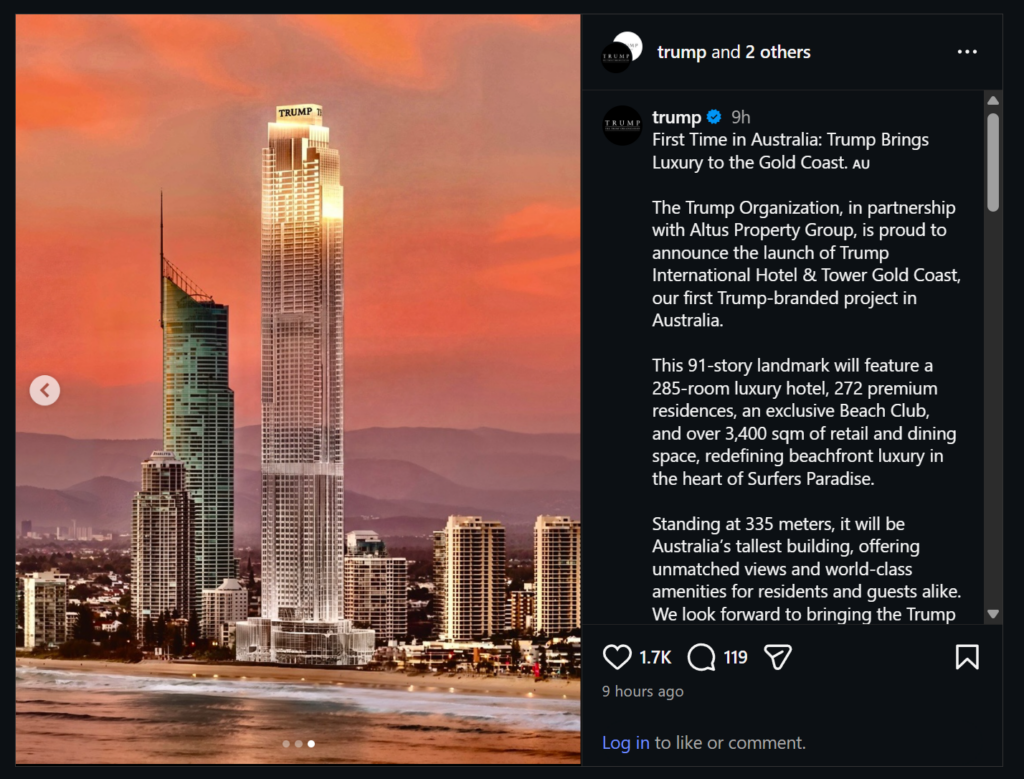
However, the project is not yet considered to have completed the statutory planning procedures. The Australian Broadcasting Corporation (ABC) quoted the Gold Coast Acting Mayor on February 24 as saying that the council has not yet received a formal development application (DA) for the project. The same report also mentioned that there is an existing approved plan for an 89-story building on the site, but a new formal application is still required for the new plan.
The positive aspect of this news for Queensland lies in the signal of investor confidence.
From a macro perspective, the reason this A$1.5 billion mixed-use project has attracted attention is not only because of the brand, but also because it represents the potential for capital to "bet" on the Gold Coast's tourism, retail, and high-end residential markets. Reuters also points out that the developer expects residential units to start at around A$5 million, and states that the project will be designed to Trump brand standards, but will be owned and built by Australian parties.
Queensland's fundamental data provides a solid foundation for this positive outlook: the Queensland Treasury, in its state budget data, projects the state's economic growth at 2.51 TP3T in 2024–25 and 2.751 TP3T in 2025–26. Nationally, the ABS reported that for the 12 months ending June 2025, Australia's population increased by 1.51 TP3T annually to approximately 27.6 million. These factors generally support employment, the service sector, and housing demand in the medium term, explaining the continued emergence of large-scale hotel + residential + commercial complexes in Southeast Queensland.
The most crucial aspect of urban planning is not "the tallest," but "whether it can be successfully implemented."
Some reports describe the project as "approved" or "given the green light," but ABC and other media outlets, citing the city council, say that a formal approval document (DA) has not yet been received. For buyers, this discrepancy represents uncertainty regarding the timeline; high-rise, waterfront, and mixed-use projects often involve considerations such as traffic impact, public space, wind conditions, infrastructure capacity, and fire evacuation. Adjustments to any of these conditions could alter the saleable area, product configuration, and delivery schedule, thereby affecting rental and sales returns.
The reality facing "landmark premium": competition is not only in the same area, but also in the same industry.
The Guardian report mentioned other taller tower proposals on the Gold Coast (such as One Park Lane at 390 meters), and also noted that authorities are awaiting formal application. This means that even if "Australia's tallest" becomes a reality, it may not monopolize the scarcity narrative in the long run. For high-end buyers, what is more important is often the location's walkability, daily amenities, management quality, and the depth of the resale market, rather than a single label.
Why Brisbane land development remains a long-term concern
Brisbane, as Australia's third-largest city, is experiencing population growth and urban renewal, driving demand for housing, retail, and commercial space. Meanwhile, infrastructure investment continues to advance; for example, the Cross River Rail project is described by officials as a core initiative to improve transportation and capacity in Southeast Queensland, bringing urban renewal and development opportunities to the areas surrounding major stations.
Furthermore, the Queensland government has positioned the 2032 Olympic Games hosting rights as a long-term factor driving investment, employment, and tourism promotion. A publicly released summary of economic analysis by the state government estimates that hosting the 2032 Olympics could generate quantifiable potential benefits of approximately AUD 8.1 billion for Queensland. For land and project investment, such long-term factors are typically reflected gradually through infrastructure development, urban renewal, and industrial clustering.
In summary, the proposed Trump-branded supertall building on the Gold Coast can be seen as an example of Queensland attracting significant capital investment. However, investment decisions should still focus on three key aspects: whether the planning process is truly implemented, whether the product and operational structure are sustainable, and whether the holding costs and exit strategies are clear. ANP's role is to break down "news buzz" into verifiable, comparable, and actionable decision-making data within the framework of buyer's brokerage, commercial property, and urban planning.

 Chinese