
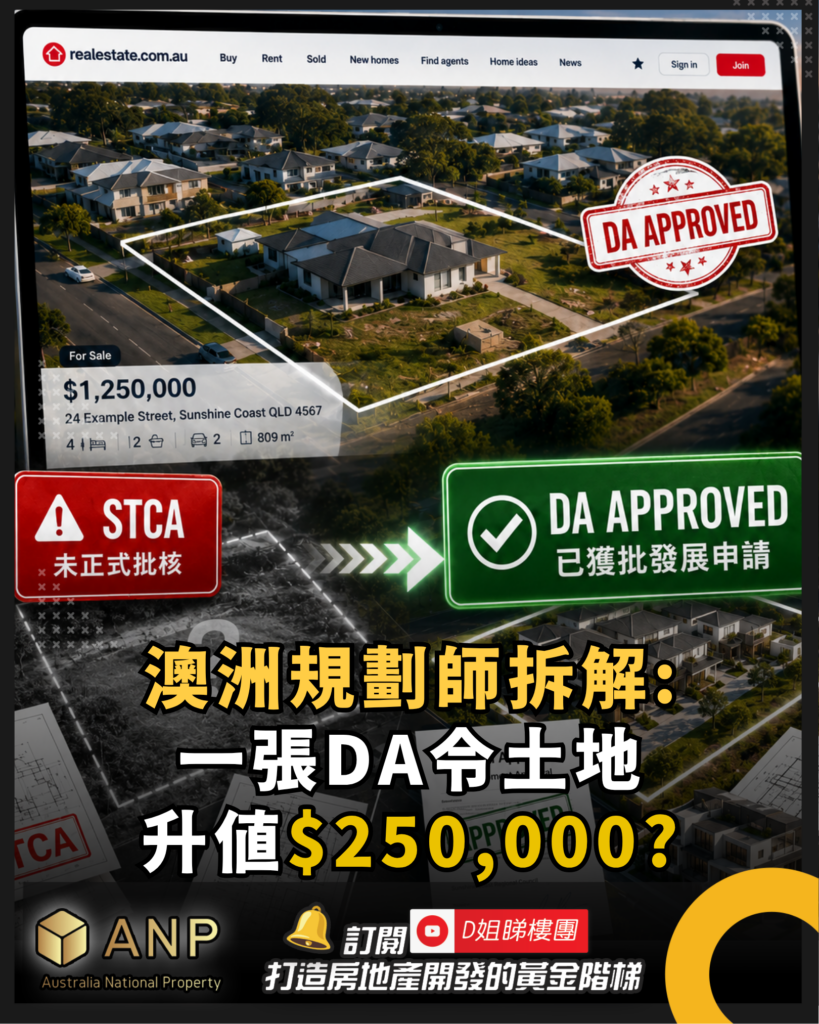
What does DA Approved mean? What do STCA and Council Approved mean in Australian property advertisements?
Australian property advertisements frequently use terms like DA Approved, STCA, and Council Approved. While these may seem like just real estate advertising terms, they can actually directly impact a property's value, risk, and resale appeal.
Contents Overview
ToggleMany Hong Kong and Asian buyers often encounter familiar yet unfamiliar terms when viewing Australian property advertisements, such as... DA Approved、STCA、Council Approved、Development ApprovalThese terms often appear in advertisements for old house lots, corner properties, main road properties, subdivided land projects, or small development sites.
On the surface, these terms seem like marketing gimmicks used by real estate agents to increase attractiveness; but from the perspective of urban planning and property investment, what these terms represent is whether a property is merely "seemingly promising" or already has a clear foundation for development.
This distinction is very important for investors.
What is STCA? It means that approval from the Council is still pending.
STCA 是 Subject to Council Approval The abbreviation can be understood in Chinese as "awaiting approval from the city council".
When an Australian property advertisement includes STCA, it usually means that the seller or agent believes the property has potential for development, such as additions, subdivision of the land, change of use, dual-family development, redevelopment, or the construction of multiple residential units. However, these development directions have not yet received formal Council approval.
In other words, STCA reflects "possibility" rather than "established rights".
This distinction is often overlooked by buyers. A property advertisement stating "potential for subdivision STCA" or "development potential STCA" does not guarantee that the land can be subdivided, nor does it guarantee that the Council will approve the proposed subdivision. The actual outcome still depends on factors such as zoning, overlays, land area, frontage, entrances/exits, parking spaces, drainage, easements, flood risk, and surrounding planning directions.
What is DA Approved? It means that the development application has been approved.
DA 是 Development Approval The abbreviation. When property advertisements include... DA ApprovedThis usually indicates that the relevant development application has been approved by the city council.
This does not mean that the project is necessarily worth investing in, nor does it mean that costs and risks can be completely ignored; but it at least shows that a development plan has been reviewed by the Council and has a relatively clear legal basis.
For buyers, the significance of DA Approved is that the property is no longer just at the stage of "potentially developable", but has a development direction accepted by the Council.
This is why DA Approved is often a key selling point in real estate advertisements. It makes it easier for buyers to understand the future use of the land and can also make the property more attractive in the market.
The biggest difference between STCA and DA Approved is that one is a possibility, and the other is already approved.
Simply put,STCA This means "there was an opportunity, but it wasn't approved";DA Approved This indicates that "an existing development plan has been approved".
The difference between the two is not just a matter of wording, but a difference in property risk, valuation logic, and investment judgment.
For STCA-approved properties, buyers typically need to assess the feasibility of the development direction themselves and bear the risk that their applications may be modified, delayed, or rejected. For DA-approved properties, part of the planning process has already been completed, and buyers can directly review the content, conditions, and feasibility of the approved plans.
However, DA Approved is not a magic bullet. Buyers still need to determine whether the approval is still valid, whether the approval conditions are reasonable, whether the infrastructure requirements are too high, whether the construction costs are controllable, and whether the development plan meets current market demands.
How does DA Approval affect property value?
For Australian property investors, there are three main reasons why DA Approval can affect property values.
First, DA Approved can reduce some of the uncertainty in planning. Buyers don't have to start from scratch guessing whether the Council will accept the intended use or design. This has practical value for developers, advanced investors, or buyers looking to shorten their decision-making time.
Second, DA Approved can save time and costs. In Australian property development, time itself is a cost. Applying, amending, submitting supplementary documents, and waiting for Council approval can all impact financial arrangements and holding costs. If the property already has DA Approval, some preliminary procedures may have already been completed.
Third, DA Approved can change the logic of property valuation. If you only look at the current condition of an ordinary old house, the market may only value it based on the condition of the land, the house, and the rental yield; but if the property comes with an approved development plan, the buyer will no longer only look at the current use, but also at the future uses that the land can realize.
Even after seeing "DA Approved," what should buyers still be wary of?
While DA Approved status is valuable, buyers shouldn't rush into the market just because they see those words.
First, examine the approval details. Different DA Approvals can have vastly different values. Approval for a small addition has a completely different impact on land value than approval for a multi-family residential development.
Secondly, check the validity period and approval conditions. Some approvals may have time limits, and may also come with requirements regarding transportation, drainage, parking, infrastructure, design modifications, or the environment. These conditions will directly affect the actual cost.
Third, it's crucial to determine if the proposed development meets market demand. Council approval of a development plan doesn't guarantee the market will be willing to accept it at the ideal price. Rent, selling price, construction costs, financing environment, and exit strategy all need to be considered.
Therefore, DA Approved is an important signal, but not an investment guarantee.
ANP's perspective as urban planners and buyer's agents
When ANP assesses Australian properties, they don't just ask, "Does this property have potential?"
What we're more concerned with is: Is this potential based on planning? Is it feasible? Is it quantifiable? Is it worth buying at today's price?
When ordinary buyers look at properties, they usually look at school districts, transportation, decoration, location and existing rental income; but urban planners will further break it down into zoning, land area, frontage, entrances and exits, parking spaces, drainage, overlays, easement, heritage, flood risk and surrounding planning directions.
On the same piece of land, an average buyer may only see an old house; a planner may see dual occupancy, subdivision, commercial conversion, rooming accommodation, or even different options such as preserving the existing building, reconfiguring its use, and improving rental returns.
When buying Australian property, don't just look at the advertising words.
When buying property in Australia, "DA Approved," "STCA," and "Council Approved" are not just decorative terms. They represent planning regulations, development risks, time costs, and property value.
Truly professional buyers don't just look at how attractive the advertisement is; they will ask further questions: Is there council support for this development potential? Is there a clear planning foundation? Is this already reflected in the asking price? If it is to be developed or resold in the future, will there still be a reasonable profit margin?
"DA Approved" isn't magic, but it's an important signal. What truly matters isn't just a few words on an advertisement, but whether the land's potential can be transformed into assessable, actionable, and quantifiable investment value.
Want to know if an Australian property truly has development potential?
ANP can provide you with pre-purchase analysis from the perspectives of urban planning, property search, Council Approval feasibility, and investment strategies.


 Chinese