
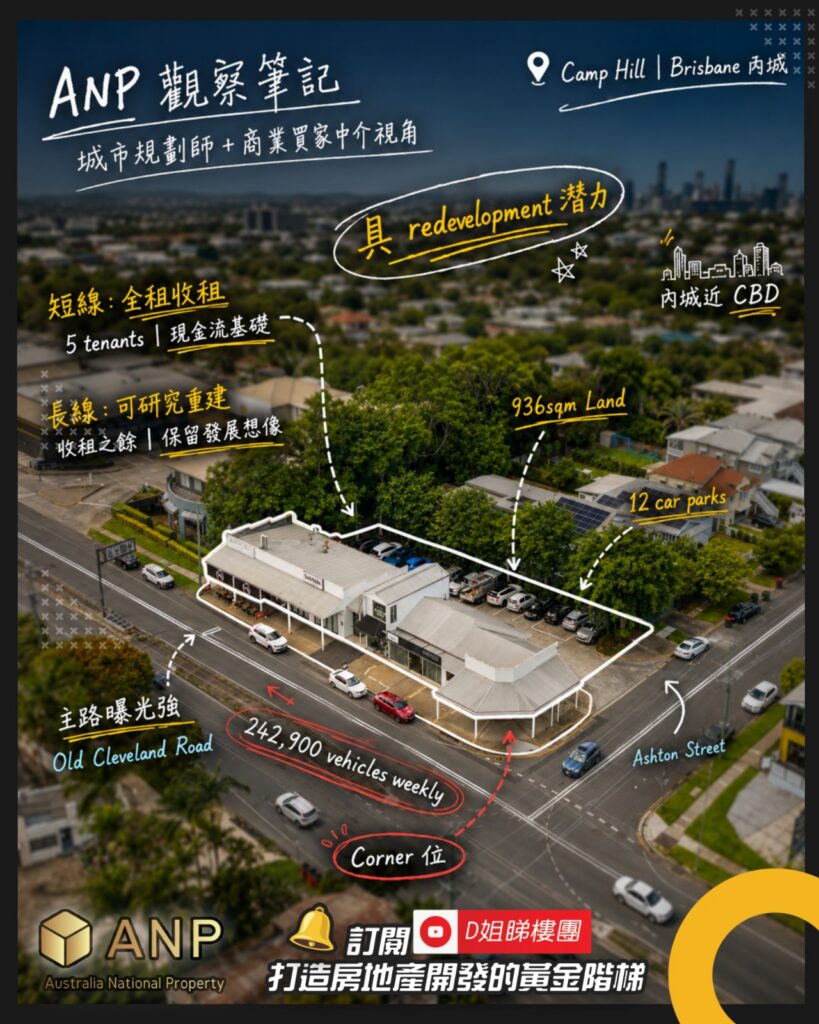
In the Brisbane commercial property market, projects that are truly worth paying attention to are often not just about rental returns, but also about three things: existing cash flow, land conditions, and future urban renewal potential.
Contents Overview
ToggleThis ANP observation is located in Camp Hill Inner City A commercial property project. The project is located in... The area around Old Cleveland Road and Ashton StreetIt is a corner site with main road exposure, adjacent to the Brisbane CBD, with a stable tenant base and potential for further redevelopment.
For commercial buyers, the core value of this type of property is not just "how much rent is collected today", but "how this land can be reinterpreted in the future".
Why are commercial properties in Camp Hill worth considering?
Camp Hill is located in the southeast of Brisbane's inner city, not far from the CBD, and boasts a well-established residential population, amenities, and transportation connections. Compared to some entirely new areas, Camp Hill's advantage lies in its already recognized location, while some corner commercial spaces still retain low density, older-style shops, and potential for reintegration.
From an urban planning perspective, commercial corner plots in inner-city areas typically have several characteristics:
First, land supply is limited.
Second, it has a high visibility due to its street-facing location.
Third, it is easy to form community-based retail, catering, professional services or medical facilities.
Fourth, if zoning, transportation, parking and building conditions are favorable, there may be research space with higher intensive use in the future.
This is precisely the biggest difference between commercial property investment and general residential investment. Residential investment mostly focuses on rent, vacancy rate, and capital appreciation; commercial property investment requires further analysis of land use, tenant structure, street visibility, vehicle flow, pedestrian flow, and future redevelopment options.
Project Highlight 1: 5 tenants provide a decentralized cash flow foundation
According to project information, the property is currently owned by 5 tenantsTenancy. For commercial investors, multi-tenant structures are generally more effective at diversifying risk than single-tenant structures.
The advantage of single-tenant properties is that they are easier to manage, but cash flow may be interrupted immediately if a tenant moves out. In contrast, with multi-tenant projects, even if one tenant changes, overall revenue may not completely stop, which helps to stabilize cash flow.
However, buyers shouldn't just look at the words "has tenants." During due diligence, each aspect still needs to be checked individually:
The lease term, option terms, rent adjustment mechanism, who is responsible for outgoings, whether there are any outstanding rent payments, whether the tenant's industry is stable, and whether it will be easy to re-rent the property after the tenant moves out.
The value of commercial properties is often hidden in the details of the lease agreement.
Project Highlight Two: 936 sqm of land, preserving future development potential.
The land area indicated for this project is approximately 936sqmFor commercial properties in Brisbane's inner city, a corner lot of nearly 1,000 square meters offers more operational flexibility than a single small shop or strata shop.
Buyers can understand this type of asset from two perspectives:
Short-term trading is about collecting rent.
The medium- to long-term approach involves studying reconstruction, renovation, additions, relocation, or optimization of use.
This does not mean that the property can be redeveloped immediately, nor does it necessarily mean that the density can be increased. Any development potential depends on zoning, planning overlay, building height, parking requirements, flood risk, heritage constraints, traffic access, council assessment, and market demand.
However, from the perspective of commercial buyers, land area, corner exposure, main road location, and existing commercial use are indeed fundamental conditions that warrant further planning due diligence.
Truly experienced buyers don't just ask "what's the current return?", but rather:
Is there a possibility that the asset value of this land will be recombined in the next 5 to 10 years?
Project Highlight 3: Exposure of Old Cleveland Road, enhancing commercial visibility.
The project is located in Old Cleveland Road This area offers prime visibility along a main road. For tenants in retail, catering, service, medical, beauty, education, fitness, or professional services sectors, exposure itself translates into commercial value.
Compared to properties hidden on inner streets, properties on main roads typically have better signage visibility, vehicular traffic contact area, and natural recognizability. These factors may not be explicitly stated on the first page of a valuation report, but they often have a substantial impact on tenants' willingness to lease and pay rent.
The accompanying images also indicate significant traffic volume on this section of road. Before making a formal assessment, buyers should verify the latest traffic data source, statistical methodology, and date to avoid relying solely on promotional materials as the basis for their final investment decision.
Project Highlight 4: 12 parking spaces, which are crucial for commercial tenants.
The presence or absence of parking spaces in commercial properties makes a significant difference in their attractiveness to tenants. This is especially true in Brisbane, where many consumer and service establishments still heavily rely on drivers for access.
This project is marked as approximately 12 car parksThis is especially important for multi-tenant commercial properties, as different tenants need to work together to support customer visits, employee parking, short-term parking, and daily operations.
For tenants in the food and beverage, clinic, physiotherapy, accounting, legal, tutoring, retail and beauty service sectors, parking convenience often directly impacts customer experience.
Therefore, parking spaces are not just ancillary facilities, but part of commercial rental capacity.
The true value of a corner site: more than just a "premium location"
Many people's first reaction to the word "corner site" is "good exposure." But from the perspective of urban planning and commercial assets, the value of a corner site goes beyond that.
Corner sites typically have more frontage, allowing for more flexible entrance and exit arrangements, larger signage display areas, and potentially greater design freedom during future renovations or reconstructions. Of course, this also requires consideration of traffic safety, vehicle access, crossovers, parking layout, and council requirements.
Simply put, a corner site is a condition that "can be redesigned," not just a place where today's tenants do business.
This is why ANP places special emphasis on street corners, land shape, road grade, surrounding building density, and future planning trends when analyzing commercial properties.
How should commercial buyers assess this type of property?
For high-net-worth buyers or overseas investors, Brisbane commercial properties cannot be viewed solely through the lens of residential investment. Rental returns are only the first layer; the real key lies in whether the asset offers multiple investment opportunities.
A commercial property worth studying should ideally possess the following potentials simultaneously:
Current rental income can cover holding costs.
The land conditions are open to future adjustments.
The location has long-term population and commercial demand.
Tenant types do not overly rely on a single industry.
The property itself can increase its value through renovation, re-leasing, restructuring, or redevelopment.
A property with high rents but inflexible land, concentrated tenant risk, and a lack of long-term demand may not be the most ideal asset. Conversely, a property that doesn't offer the highest apparent returns but possesses land scarcity, main road exposure, parking, corner location, and future development potential is worth further investigation.
ANP's perspective: When buying commercial property, you should buy both "today's income" and "tomorrow's options."
The most attractive aspect of inner-city commercial locations like Camp Hill is not just the number itself, but the fact that it possesses two values simultaneously:
First, there is the cash flow generated by existing tenants;
Secondly, there is the potential for future redevelopment.
This is the core of commercial property investment: you're not just buying a shop, but a location, a piece of land, a lease, and the option to adapt to future urban changes.
For buyers looking for commercial properties in Brisbane, Australian shops, mixed-use sites, or land with redevelopment potential, the most important thing is not to blindly chase high returns, but to first establish a clear judgment framework.
ANP Australia National Property assists buyers in analyzing property location, lease, land conditions, regional supply and demand, and future appreciation potential from the perspective of urban planners and commercial buyer agents, avoiding being swayed by superficial rental prices or sales pitches.
If you are considering investing in Australian commercial properties, especially in Brisbane, Queensland, or projects with redevelopment potential, you can discuss with the ANP team to make a more comprehensive assessment from the perspectives of cash flow, risk, and long-term development.
FAQ
Is Camp Hill a good place to invest in commercial properties?
Camp Hill is located in the mature inner-city area of Brisbane, close to the CBD, with a relatively stable foundation of residential and lifestyle amenities. Whether it is suitable for investment depends on the specific property location, lease, land size, zoning, parking, and future planning conditions.
Are commercial properties better than residential properties?
Commercial and residential properties have different risk structures. Commercial properties typically have longer leases and potentially higher returns, but vacancy periods, tenant quality, bank loan terms, and maintenance responsibilities all require more careful analysis.
Does "redevelopment potential" necessarily mean that reconstruction is possible?
No. Redevelopment potential only indicates that the property possesses conditions worthy of study, such as land area, location, street corner, main road exposure, or existing use. Whether it can ultimately be redeveloped depends on council planning, zoning, overlay, transportation, parking, building restrictions, and market feasibility.
What should you check before buying commercial property in Brisbane?
Buyers should check the lease, rent, outgoings, zoning, planning overlay, building condition, car parking, flood risk, environmental issues, tenant history, market rent, and future re-rentalability.
How can ANP assist business buyers?
ANP can assist buyers in screening projects, analyzing areas, reviewing lease highlights, researching land and redevelopment potential, and helping them understand whether a property aligns with their cash flow, asset allocation, and long-term growth goals.




 Chinese