
When it comes to building a house, many people still think of a design drawing and a builder's quote. However, real residential construction is never something that can be completed simply by looking at the plans and confirming the price. For those preparing to build their own home, it's crucial to understand that building a house is essentially a complete project, not just a single quote document.
This concept is important because, throughout the entire house-building process, what truly affects the outcome is often not a single number, but rather whether cost control and time management are done properly.
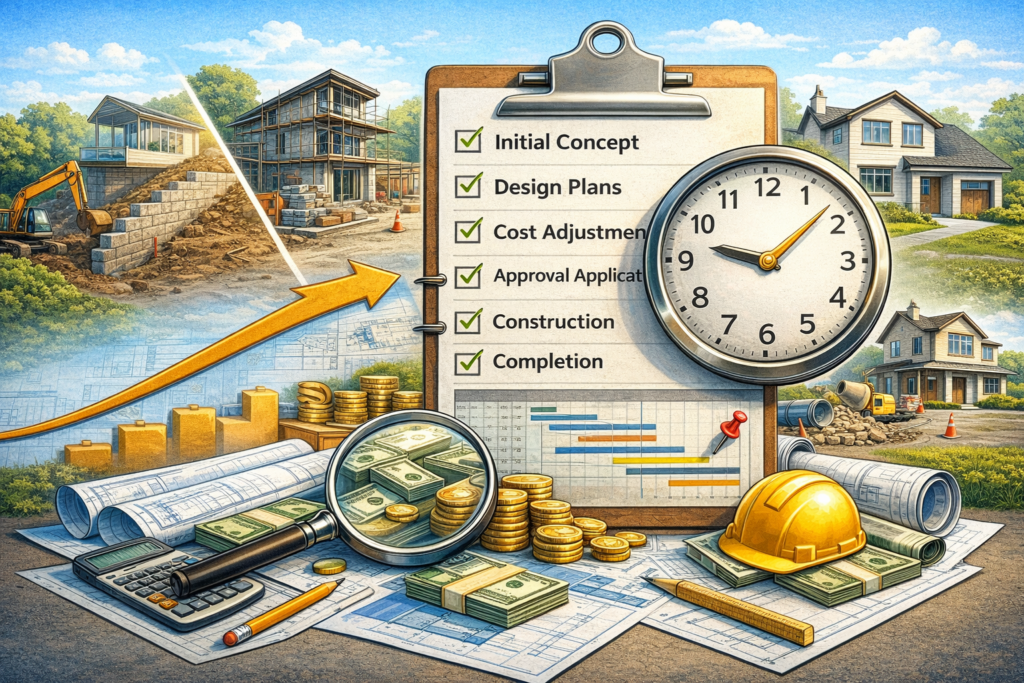
In practice, a residential building project typically goes through several main stages. The initial stage usually begins with a preliminary concept, establishing the overall direction, including spatial requirements, site conditions, design orientation, and a rough budget. This is followed by design drawings, gradually developing the concept into more concrete plans and technical documents. The next step is usually cost adjustment, which involves reassessing the overall budget's feasibility based on the design content, materials, construction methods, and site conditions. After that, approval applications are required; only after these approvals are obtained will the project officially enter the construction phase, culminating in completion and handover. This process is consistent with the current building practices in Queensland, as most residential projects require building approval before construction begins, and certifiers conduct inspections and certifications at specific stages of construction.
In other words, the timeline for building construction is not a simple straight line, but a series of interconnected processes. Each step can simultaneously affect both time and cost.
For example, if the owner keeps modifying the floor plan, exterior style, and material specifications during the early design phase, the design time will naturally be extended, and subsequent engineering consultants, cost estimates, and even approval documents may need to be readjusted. If you rush to see the builder's quote before the design is finalized, many figures will only be preliminary estimates and will not reflect the final true cost. QBCC also reminds owners to pay attention to hidden costs, payment terms, timelines, and availability when comparing quotes, because the real risk is often not just in the price itself, but in whether the quote fully reflects the time and cost variables.
Approval timelines are another often underestimated factor. Queensland official data indicates that most domestic building work requires building development approval before commencement, and building certification and inspections also follow related procedures. This means that even if the design is complete, construction may not begin on schedule if the approval process is not yet finished. If buyers or investors are under financial pressure, approval delays can directly impact overall cash flow.
Furthermore, site conditions are another crucial factor that simultaneously impacts both time and cost. If site conditions are more complex than expected—for example, poor soil conditions, high drainage requirements, or unfavorable terrain—it may necessitate adjustments to the engineering plan and even extend the construction period. The same applies to material selection; as a project upgrades from basic specifications to higher-end finishes, it often involves not only increased prices but also longer procurement, coordination, and installation timelines. This explains why, even for the same residential project with similar area, the final cost and construction period can still differ significantly. This fluctuation is essentially a project management issue, not just a matter of building unit price.
Therefore, if you are really planning to build a house, it's best to manage it as a complete project, rather than focusing solely on a single builder's quote. Complete management doesn't mean every homeowner needs to become a construction expert, but rather understanding a few core principles: clearly understand the costs, allow for flexibility in the timeline, and anticipate potential risks as early as possible.
In terms of cost, one should not only consider the main building cost, but also design fees, consultant fees, approval fees, site conditions, material upgrades, external works, and any adjustments that may occur during construction. Regarding time, it's crucial to understand that design, approval, scheduling, construction, inspection, and finishing are a continuous process; delays in any stage can increase overall costs. As for risks, the earlier problems are identified, such as site limitations, design difficulties, or insufficient funding, the better the opportunity to make adjustments before the project officially begins. The QBCC also points out that for contracts of AUD 20,000 or more, the builder should provide the owner with a commencement notice within 10 working days of officially commencing work on site. This reflects that residential construction is a formal project with procedural and milestone management requirements, not something that can be handled with a simple verbal agreement.
From an investment perspective, this project mindset is particularly important. Because if costs are well controlled and timelines are managed reasonably, building can indeed be a method with added value potential. Whether it's upgrading a residence, rebuilding, or a small development, good project process management can amplify the final results and value. Conversely, if a project is rushed, or if too many cost and time risks are ignored in the early stages, the entire process can easily become passive, and it may even be discovered midway through construction that the budget and time are out of control.
In summary, what truly matters when building a house is not just whether the design drawings are beautiful or the builder's quote is attractive, but whether the overall project's cost control and timeline are reasonable. When you understand house construction as a complete project, many problems that initially seem unavoidable become easier to predict and manage. This approach not only makes the budget clearer but also ensures a more stable construction process.
This article is for general informational purposes only and does not constitute legal, architectural, engineering, tax, or investment advice; individual cases require consultation with professionals based on specific circumstances.




 Chinese