

When many people think about investing in Australian real estate, their first reaction is location, property price, rent, school district, and interest rates. These are certainly important, but if you only stay at this level, you are still thinking like a "buyer" and haven't truly entered the realm of "investor thinking."
Contents Overview
ToggleThose who truly have the ability to understand property more deeply are often not the best storytellers, but those who best understand how to read the city.
The value of a property is never determined solely by its current renovations, size, and rent; it is shaped by the city's structure, planning direction, legal boundaries, land potential, and future changes in the surrounding environment. This is precisely ANP's core strength. ANP's website states that its team is grounded in urban planning and land development, bringing a professional perspective of town planning to real estate investment and project analysis. This helps clients not only "buy property," but also systematically understand the underlying value-added logic of the property.
In other words, ordinary buyers see a house; urban planners see whether an asset can be valued more by the city in the next five or ten years.
Why do many people struggle to buy Australian real estate, yet fail to make the right purchases?
Many investors are actually very diligent. They look at transaction data, compare rental yields, research median prices in different areas, and even track interest rate trends. The problem isn't that they don't work hard, but that the data is fragmented.
They know the area is appreciating rapidly, but they don't know if the increase is driven by short-term sentiment or supported by deeper factors such as infrastructure development, population inflow, and relaxed planning regulations. They know a certain house "looks good," but they don't know if the adjacent plots will see medium- to high-density development, road works, commercial expansion, or even affect privacy, noise, and resale value. They know a certain location is popular, but they don't know what overlay or planning restrictions the property itself is subject to, and whether it is feasible to add, subdivide, or rebuild in the future.
A recent ANP article has actually pointed this out: for buyers, the real difficulty is not "whether they have the information," but rather not knowing what information to look for, or how to translate planning information such as zoning, overlays, and neighborhood plans into actionable home-buying decisions.
Therefore, the most important dividing line in Australian real estate investment is not how many properties you've viewed, but whether you have a system for judging them.
What is the biggest difference between urban planners and ordinary buyers when inspecting properties?
Buyers typically look at surface-level conditions, while urban planners look at spatial rules.
Superficial conditions are easy to understand, such as three bedrooms and two living rooms, good school district, convenient transportation, and stable rent. But spatial rules truly determine the upper limit of this asset. This includes the zoning category of the land it is located on, whether it is subject to character or heritage restrictions, whether it is a flood overlay, whether it is under a specific neighborhood plan, whether there are major infrastructure projects or potential land use changes nearby, and whether it can be used for secondary dwelling, expansion, renovation, or even redevelopment of the land in the future.
In its internal article, ANP has clearly summarized this method as "first use City Plan to define what is permissible and what is not permissible," and pointed out that this planner's perspective can determine earlier whether there will be medium-to-high density, commercial use, or major development next to the property, and can also estimate the feasibility and cost of investment use or expansion earlier.
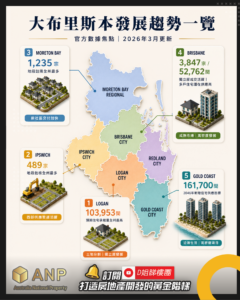
This capability is particularly important for Australian real estate investment, as the value growth of many Australian cities is closely related to population growth, infrastructure investment, urban expansion, and planning shifts. ANP's recent Brisbane coverage follows this line of thought: the continued attention on the Brisbane market is linked to population growth and infrastructure investment.
The question isn't "Is it worth buying?", but rather "What will this land become in the future?"
A basic question is: Is this room pretty or not?
The intermediate question is: Will this area level up?
The advanced question is: What role will this land play in the urban system in the future?
A place that is merely "livable" may not necessarily have the greatest potential for investment growth; however, if it is located on the edge of a population spillover path, an infrastructure extension node, or a region where planning density is being reassessed, then its asset value will not only rise with the market, but may also be reassessed as the city redefines its use.
This is why ANP has long emphasized land potential and development logic, rather than just focusing on property sales. Its Chinese homepage states that ANP helps clients transform potentially valuable land into high-value residential projects and showcases the appreciation potential of some investment cases; its services also cover land development, commercial property sales, and full-cycle support.
Investing in property is never about buying a finished product, but about buying a future that is not yet fully understood by the market.
Investing in Australian real estate: "Hidden risks" that cannot be ignored.
The more people talk about opportunities, the more they need to talk about risks. Because advanced investing is not about optimism, but about anticipating risks early on.
For example, in Brisbane, some pre-war buildings are protected under character overlay or similar planning restrictions. ANP has specifically pointed out that certain residences built before 1946, if located within a Traditional Building Character Overlay, cannot have their exterior or main structure arbitrarily demolished. This means that if investors only see the land and the house but ignore planning restrictions, their future additions, rebuilding, and renovation strategies may be significantly limited.
Similarly, if a property appears to have good rental income, but there is a possibility of high-density development nearby, or it falls within a certain area of flood, traffic, noise, or landscape restrictions, the risks and difficulties of exiting the purchase are often not obvious at the time of purchase.
Therefore, the real expense of buying property in Australia is not necessarily buying at a high price, but buying the wrong property.
If you buy at a high price, there's still a chance for the market to recover; if you buy at the wrong price, it's often because the asset structure itself is flawed.
Why are Brisbane and Queensland particularly suitable for investment from an urban planner's perspective?
Because this is not a "fully mature market with its story already told".
Many areas in Sydney are already highly developed with strong market consensus; however, in Brisbane and the wider Queensland, many areas are still undergoing urban reassessment, population redistribution, infrastructure spillover, and land use upgrades. What does this mean? It means that relying solely on traditional real estate indicators may not be sufficient; rather, those who better understand urban planning, land supply, and future development flexibility have a greater chance of discovering value ahead of the market.
ANP itself centers around Greater Brisbane, focusing on town planning and land development, and continuously providing content related to buying property in Brisbane, the Queensland market, and planning interpretation. This brand structure is well-suited for addressing the keyword "Australian real estate investment," but instead of using generalities, it builds professional trust through a "planner's perspective."
A property worth holding long-term typically has these characteristics.
It may not be the most glamorous, but it often has several common features.
First, its location has a clear population absorption capacity, not just short-term speculation. Second, the surrounding urban functions and infrastructure are continuous, not isolated. Third, the degree of planning restrictions on it is controllable, preventing excessive pressure on future usage flexibility. Fourth, it is not only easy to rent out today, but also easy for the next buyer to understand and take over in the future. Fifth, the land or building form it occupies has a certain degree of reconfiguration space, whether it is expansion, addition, improvement, or simply enjoying a higher valuation due to its planned location.
Many of these conditions cannot be discerned solely from real estate platforms or advertising copy; rather, they require individuals with an understanding of planning and urban structure to effectively filter them out.
The key to investing in Australian real estate is not chasing trends, but understanding "sustainable appreciation."
The market loves to chase hot topics, but hot topics do not equal long-term value.
The assets that are truly worth investing in are not the ones that will be most exciting in the short term, but rather those whose location, planning position, flexibility of use, population carrying capacity, and resale logic still hold true even after the market cools down.
This is why, for sophisticated investors, real estate investment is not just about buying property, but about capital allocation. You're not asking "Will it appreciate?", but rather "Does this asset have enough multiple supports to make it more stable across different market cycles?"
ANP's strength lies precisely in placing market analysis, property selection, and planning interpretation within the same framework. This approach reduces blind spots for first-time investors and enhances portfolio optimization capabilities for those who already own assets.
In conclusion, truly savvy Australian real estate investment involves understanding the city early on, rather than chasing the market afterward.
Many people think that real estate investment relies on courage, but it actually relies more on understanding.
While others are only looking at property prices, rents, and renovations, you're already considering zoning, overlay, development logic, urban expansion paths, and land potential. While others are only asking how much this house will sell for today, you're already asking what this land will become in five years. This difference ultimately reflects not just a difference in perspective, but also a difference in return structure.
If you are researching Australian real estate investment, especially in the Brisbane and Queensland markets, and are looking for assets that are not just "worth buying" but "worth holding long-term," then what you really need is not just sales pitches, but professional judgment that can combine urban planning, land potential, and investment logic.
This is precisely the value that ANP can provide: not by making properties sound more appealing, but by making investments clearer.




 Chinese