
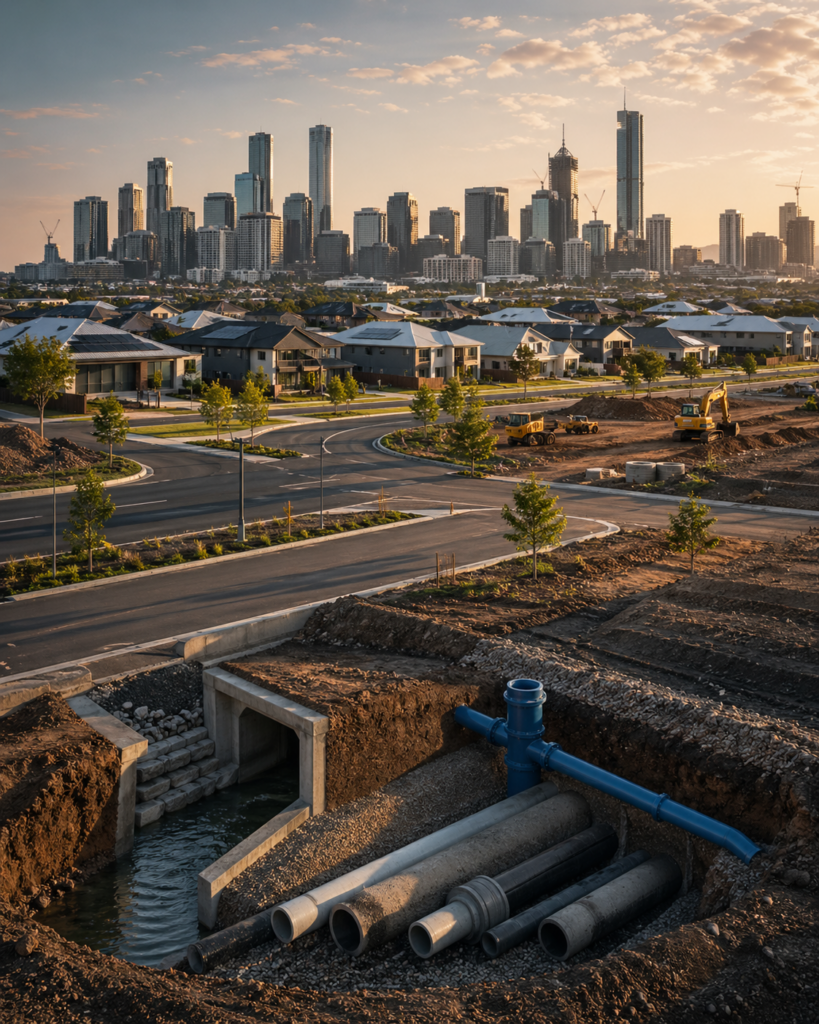
Queensland housing supply enters "infrastructure unlocking" phase
In recent years, the Australian property market has faced challenges such as insufficient housing supply, population growth, and rental pressure. For Queensland, the issue is not simply "whether there is land," but whether the land can truly be developed into habitable housing.
Contents Overview
ToggleThe Queensland government launched a total amount A$2 billion Residential Activation FundThis is precisely aimed at this core issue. The fund is primarily used to accelerate the infrastructure needed for residential development, including water pipes, drainage, sewers, roads, transport connections, electricity, and communication networks. In other words, the government is moving beyond simply discussing land supply to addressing the infrastructure bottleneck that ultimately enables housing development. Queensland government data shows that the fund is used to expedite trunk and essential infrastructure and support the release of infill and greenfield housing land.
What is a Residential Activation Fund?
Residential Activation Fund It is an important policy tool of the Queensland government to promote housing supply, with the goal of assisting local governments, developers and landholders in promoting eligible housing-related infrastructure projects.
Simply put, before a house can actually be built, there must first be:
Water pipe and sewage ditch infrastructure
Residential projects require a stable water supply and wastewater treatment capacity. If the sewer capacity is insufficient, even if the land has been designated for residential use, development may not be possible immediately.
Road and traffic connections
New residential areas require upgrades to roads and intersections, public transportation connections, and pedestrian/bicycle amenities; otherwise, the completion of a large number of residences will put pressure on community traffic.
Drainage and flood control works
Many areas in Queensland are affected by stormwater, flood overlay, or inadequate drainage capacity. Insufficient drainage can directly impact the suitability of land for subdivision or development.
Power and communication connections
Modern residential development also requires access to electricity, communications, and related services. Without these amenities, it is difficult to quickly bring residential supply to market.
Government data indicates that the first round of funding has already been deployed across the state to nearly [amount missing]. 1 billion Australian dollarsIt will be used in multiple infrastructure projects and is expected to release more than [amount missing]. 98,000 new homes.
Why is this good news for Queensland real estate?
For the real estate market, rising housing prices are just a superficial phenomenon; what truly affects long-term development is whether the supply of housing can continue to increase and whether land can be transformed from "planned for development" to "actually suitable for building".
Many plots of land, despite having residential designations, may still be unable to commence construction if essential infrastructure such as irrigation canals, roads, drainage, and electricity is lacking. These plots can be termed "supply on paper": they appear to have development potential, but are still a long way from being actually launched on the market.
The importance of the Residential Activation Fund lies in its direct addressing of these initial obstacles. When the government invests in infrastructure, the developability of land can be improved, and residential projects can enter the market more quickly.
What impact will this have on land development in Brisbane and Queensland?
1. It will help release more residential land.
The fund supports developed regions infill housingIt also supports new development areas greenfield housingThis means that the policy is not only focused on downtown redevelopment, but also includes peripheral growth corridors and new residential areas.
2. Favorable land subdivision and House & Land projects
For projects such as land subdivisions, house and land packages, and masterplanned communities, irrigation canals, roads, and drainage are the most important prerequisites. If these infrastructure facilities are gradually improved, the difficulty of project implementation may decrease.
3. Support the development of regional urban and rural areas.
The Queensland government has indicated that at least half of the entire fund will be invested in regional, rural, and remote local government areas outside of South East Queensland. This will help support housing supply in different parts of Queensland and prevent excessive growth from being concentrated in Brisbane and surrounding cities.
4. Improve the long-term housing supply structure
This type of infrastructure investment may not necessarily lead to a large number of houses being built immediately, but it is the first step in the housing supply chain. Without canals, roads, and drainage, there is no truly feasible housing development.
Why should investors pay attention to these types of infrastructure policies?
For Australian property investors, choosing a region should not only focus on the current rate of increase in property prices, but also on government infrastructure, population inflow, land supply, and planning direction.
The Residential Activation Fund reflects the Queensland government's proactive efforts to boost housing supply and address practical bottlenecks in land development. This is particularly relevant for the following buyers:
First-time homebuyers
Improved infrastructure will help bring more new residential projects to market, providing buyers with more choices.
Long-term property investors
Regions with infrastructure, planning, and demand are usually more worthy of study in terms of long-term carrying capacity.
Land and development buyers
If the target is a subdivided land, house and land, or a plot of land with development potential, the availability of nearby government infrastructure investment will be an important factor to consider.
Overseas buyers and immigrant families
For families planning to relocate to Australia, allocate assets in Australia, or make long-term arrangements for their children's education, it is worthwhile to learn about Queensland's infrastructure development and housing supply policies as early as possible.
Long-term potential of Queensland's property market
Queensland's real estate market has been attracting much attention in recent years due to population growth, relatively low cost of living, attractive living environment, and expectations for urban development related to the Brisbane 2032 Olympics.
However, what truly supports long-term market growth is not just short-term buyer sentiment, but the government's ability to continuously improve urban carrying capacity. The Residential Activation Fund reflects Queensland's efforts to pave the way for future population growth by converting more land into truly habitable, developable, and supplyable housing through projects in waterways, roads, drainage, transportation, electricity, and communications.
From this perspective, the Queensland property market still has enormous development potential. For buyers intending to enter the Australian property market, researching different regions, understanding infrastructure trends, and seizing the right time to enter the market early will be more important than simply waiting for property price changes.
ANP: Assisting buyers in securing property opportunities in Queensland and Australia
ANP (Australia National Property) focuses on properties in major Australian cities, including Brisbane, the Gold Coast, Melbourne, Sydney, and other areas with growth potential. We assist buyers in analyzing the market, comparing regions, understanding project backgrounds, and matching suitable Australian property options according to budget, intended use, and long-term goals.
Queensland is entering a new phase driven by infrastructure, population, and housing supply. For buyers looking to invest in Australian real estate, now is a crucial time to reassess the Brisbane and Queensland markets.
For information on Queensland real estate, Brisbane property investment, land development potential, or new building projects in Australia, please contact us. ANP The team can obtain more specific market analysis and project recommendations.
Frequently Asked Questions (FAQ)
What is a Residential Activation Fund?
The Residential Activation Fund is a $2 billion residential infrastructure fund launched by the Queensland government. Its goal is to accelerate the construction of infrastructure such as canals, roads, drainage, electricity and communications, and to help more residential land enter the development stage.
What impact will this fund have on Brisbane real estate?
The fund will help improve the pre-development infrastructure needed for residential development, making it easier to convert some land from the planning stage into buildable housing supply. This will help support medium- to long-term housing supply in Brisbane and the surrounding growth areas.
Does this mean that Queensland house prices will definitely rise?
Any real estate market is influenced by a variety of factors, including interest rates, supply, population, employment, and policies, so there's no simple guarantee that housing prices will rise. However, infrastructure investment is often an important reference factor for assessing a region's long-term development potential.
Is now a good time to invest in Queensland property?
Whether it's suitable to enter the market depends on individual budget, borrowing capacity, holding period, investment goals, and risk tolerance. Buyers are advised to understand the infrastructure, population, rental market, and supply situation in different areas before entering the market and to seek professional analysis.
What kind of assistance can ANP provide?
ANP can help buyers analyze property opportunities in different cities and regions of Australia, understand project background, regional development, infrastructure planning and investment logic, and help buyers make more informed decisions.

 Chinese