
Australian property investment often begins with a few basic questions: Is the location ideal? Is the rental income stable? Is the rate of return reasonable? Is there sufficient potential for future appreciation? However, from an urban planner's perspective, the true value of a property depends not only on current rental income or surrounding transaction prices, but also on whether the property still has untapped development potential under the Council's planning system.
Contents Overview
ToggleThis is precisely the core meaning of Council Approval.
Council approval is not merely an administrative procedure that occurs after a property is purchased. For sophisticated buyers, it should be an important tool for assessing property value, risks, and development potential before making a purchase. A property may appear to be just an old house, a shop, a vacant lot, or a low-density site; however, if its zoning, land conditions, road connections, parking requirements, and surrounding planning are favorable, it may have the potential for additions, rezoning, dual-occupancy, land subdivision, or even long-term redevelopment.
The problem is that the market's perception of "potential" is often too general. Truly valuable development potential must be verifiable through planning regulations. Before making a purchase decision, buyers should understand the judgment processes required to transform a property from "seemingly potential" to "truly feasible."
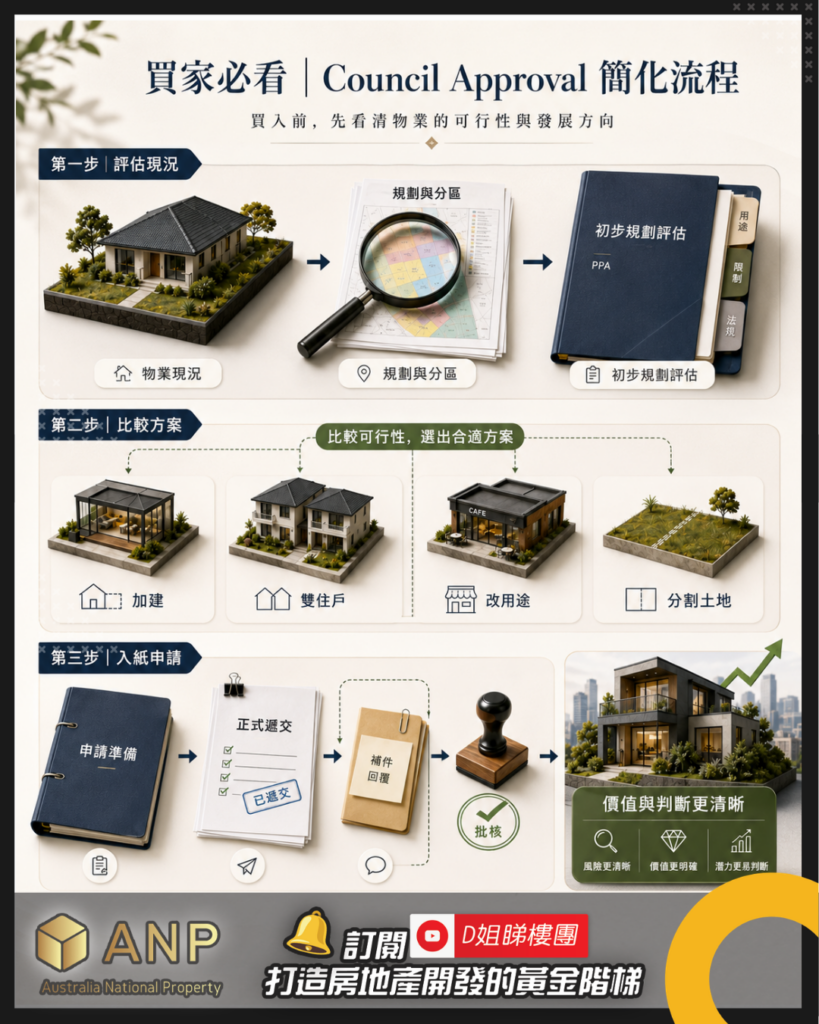
Step 1: Assess the current condition of the property and confirm whether its development potential has a legal basis.
The most common misjudgment by buyers is judging the development potential of a property solely based on its surface appearance. For example, a large plot of land does not necessarily mean it can be subdivided; an old house located on a corner plot does not necessarily mean it is suitable for redevelopment; and a commercial property near a main road does not mean that any use will be approved.
Therefore, the first step in the Council Approval process is not to immediately design a plan or prepare paperwork, but to assess the current condition of the property.
This phase requires understanding the property's current legal use, land zoning, existing building conditions, road access, parking arrangements, drainage, and surrounding environmental restrictions. It also requires checking for issues such as flood overlay, heritage overlay, vegetation protection, easement, bushfire risk, or other planning restrictions.
For buyers, the key point at this step is not simply to determine "whether it can be developed", but to confirm whether the proposed development of the property has a legal basis.
If a property itself is subject to significant restrictions, even if it appears to have development potential, its actual feasibility may be quite limited. Conversely, some ordinary-looking commercial properties or low-density sites, if located within suitable zoning and possessing good access, frontage, and land configuration, may have undervalued planning potential.
Therefore, the planning assessment before purchase is actually to help buyers avoid buying a property with "limited development potential" at "development land price".
Step 2: Understand zoning and planning controls, and determine feasible directions.
Zoning is the first planning foundation for assessing a property's development potential. Different zonings have different requirements regarding land use, building height, density, street frontage, parking, setbacks, and surrounding impacts.
Taking commercial properties as an example, the potential uses of a single property located within a centre zone, mixed-use zone, or neighborhood centre may include retail, food and beverage, office, medical, showroom, service industry, and even, under certain conditions, residential or mixed-use elements. These differences in use directly affect rental yield, buyer demographics, and long-term exit strategies.
The same applies to residential land. Whether an old house can be expanded, converted into a double dwelling, have a secondary dwelling added, or be further considered for subdivision depends on the Council's planning framework, not simply on the size of the land.
However, zoning is only the first layer. True feasibility requires further analysis of planning controls, including building height, site cover, setback, car parking, access, landscaping, neighborhood character, overlays, and assessment pathways.
These factors collectively determine whether a solution can be implemented directly and requires code assessment, or whether it may involve a higher level of impact assessment. For buyers, these differences are not merely technical issues, but also issues of time, cost, and risk.
A seemingly high-return development plan may not be suitable as a basis for investment if the approval process is too lengthy, the consulting costs are too high, or there is a significant risk of opposition. Conversely, a simpler repurposing or tenant mix adjustment that can quickly increase rental income may be more in line with investment objectives.
Step 3: Compare different options; avoid locking onto a single path too early.
Another common problem for property buyers is locking in a development direction too early in the initial assessment phase. For example, they might only ask if a certain plot of land can be subdivided, if a certain house can be converted into a double-occupancy unit, or if a certain commercial space can be converted into a restaurant.
Urban planners should first compare multiple feasible options horizontally, and then determine which one best meets the property conditions, approval risks, and investment objectives.
For the same property, there may be several different levels of options available at the same time.
Adding to a property may be less costly and easier to approve, but the value increase is limited. Dual-occupancy or secondary dwellings may increase income, but land size, design, parking, and privacy requirements must be considered. Changing the land use is particularly important for commercial properties, as it can directly alter rental levels and tenant quality. Subdividing or redeveloping the land offers higher potential value appreciation, but involves higher costs, longer processing times, and more complex approval conditions.
Therefore, what buyers really need to judge is not whether a certain option is "possible", but which option is most worth implementing.
This is especially important for commercial properties. The value of commercial properties comes not only from existing rents, but also from their flexibility in use, tenant mix, street exposure, parking, and compatibility with area redevelopment. An underutilized commercial property may have its value determined solely by its existing lease if planning analysis reveals that it can be repurposed for higher-demand uses or that its tenancy mix can be restructured.
Step 4: Select the best option and translate development potential into investment decisions.
Council approval is not simply about obtaining "approval." For buyers, the more important thing is to determine whether the approval pathway is worth the investment.
Even if a plan is theoretically approved, it doesn't necessarily mean it's worth pursuing. Buyers need to consider approval time, consulting costs, construction costs, capital tied up, potential Council requirements, and whether it will ultimately lead to increased rental income or capital appreciation.
In other words, the purpose of planning analysis is to transform vague development ideas into comparable investment judgments.
A savvy buyer shouldn't just ask, "Will this proposal be approved?"
The more appropriate question should be: "Even if approval is granted, is it worthwhile to bear the time, cost, and risk at the current purchase price?"
This is also where the value of urban planners' involvement in property investment decisions lies. Planners do more than just assist in obtaining approvals; they help buyers understand the regulatory conditions, approval risks, and value logic behind different options.
Completing this analysis before buying can help buyers more accurately determine whether a property is undervalued, over-packaged, or worth holding for the long term.
Step 5: Submitting the application is the result of the assessment, not the starting point.
Once the buyer selects the most suitable option, the formal application process begins. This stage typically involves preparing a development application, planning report, design drawings, and relevant consultant documents, such as traffic, stormwater, acoustic, landscape, heritage, or environmental assessments.
Depending on the complexity of the project, a pre-lodgement discussion with the Council may be necessary before applying to understand the Council's initial attitude and main concerns regarding the proposal.
After formal submission, the Council may request additional information, i.e., a Request for Further Information. This does not necessarily mean the application has failed, but is a common part of the approval process. The key is whether the applicant can demonstrate that the proposal meets the relevant planning requirements with clear planning rationale, technical data, and design responses.
Therefore, the paper application should not be regarded as the first step in the whole process, but rather as a natural result after the preliminary assessment, comparison of options, and risk assessment are completed.
If buyers invest in design and application costs before fully understanding zoning, site constraints, and the approval pathway, it often leads to a waste of time and money. Conversely, if preliminary planning and analysis are completed before the purchase, the entire application process becomes more focused and better serves the investment objectives.
In conclusion: Before buying property, one should first assess its verifiable potential.
Australian property investment should not be limited to rental returns and current valuations. For commercial properties, corner lots, old house sites, main road frontages, or assets with redevelopment potential, the real key often lies in whether their planning potential can be supported by a council framework.
"Potential" is not just a sales tactic, but rather a set of verifiable analytical results.
Before purchasing a property, buyers should understand its current condition, zoning, planning controls, site constraints, feasible options, and approval pathway. Only after these factors are clearly analyzed can buyers determine whether the property's development potential is genuine, whether the purchase price is reasonable, and whether there is an opportunity to increase asset value through Council Approval in the future.
ANP's urban planner perspective helps buyers understand, before making an investment decision, how far a property can go under the planning system, not just its current rent and appearance.
Before buying Australian property, the real questions worth asking are not:
"How much is this property worth now?"
Instead:
"Under the framework of Council Approval, does this property possess the potential to be verifiable, enforceable, and market-repriced?"




 Chinese