
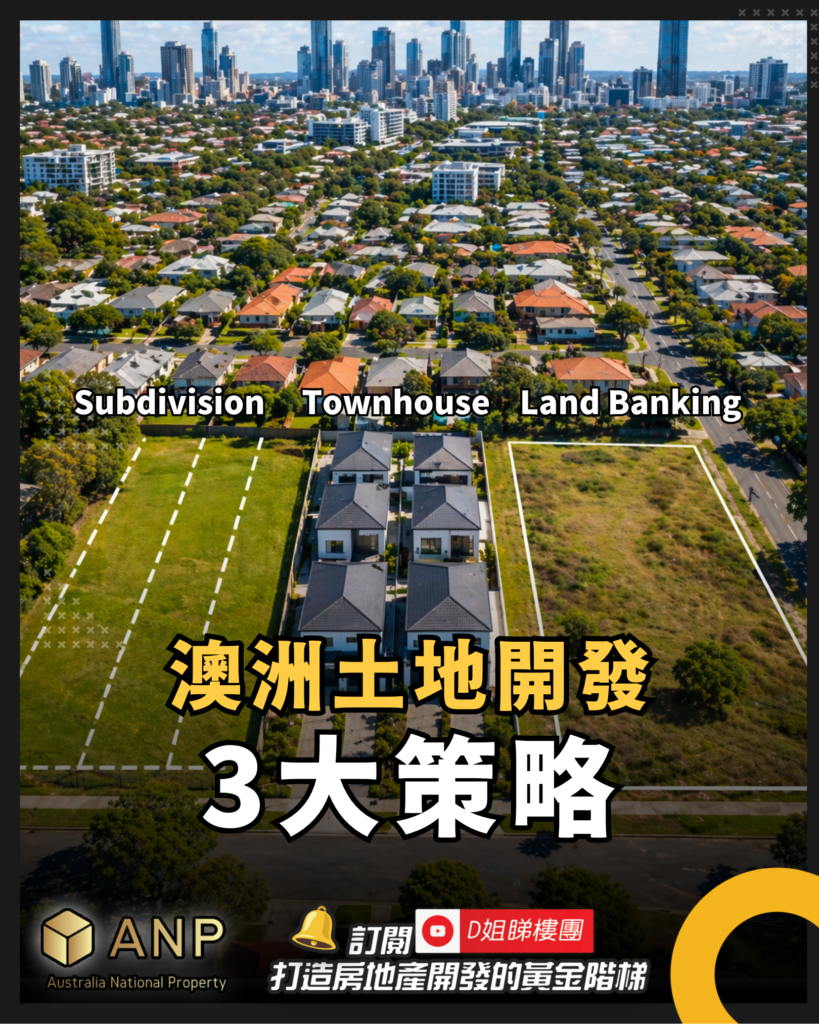
In the Australian property market, as investors move from simply buying properties for rental income to more proactive asset allocation, "land development strategy" often becomes the next crucial issue. The question isn't just about having the funds, but rather which entry model to choose that aligns with their capital size, risk tolerance, timeline, and market assessment.
Contents Overview
ToggleFor many beginners, the three most frequently heard strategies include Subdivision (land division)、Townhouse Development,as well as Land BankingAll three are related to land, but they differ in essence, capital requirements, risk structure, and return model.
Some strategies are geared towards short- to medium-term execution, emphasizing planning and cash recovery; others are geared towards medium- to long-term holding, relying on regional growth and policy changes. If investors don't understand the differences, they can easily enter the market because it "looks promising," only to find that the project is completely unsuitable for them.
This article will break down the core concepts, advantages and disadvantages, and suitable investor types of these three common land development strategies to help you better determine which path is more worth considering.
Why is choosing the right development strategy more important than blindly buying land?
The Australian land market is never one where buying a piece of land automatically guarantees appreciation. Even with the same piece of land, different strategies will lead to significantly different costs, timelines, technical barriers, and exit strategies. In other words, what truly matters is not "what land to buy," but "how you intend to use that land."
For example, some land is suitable for subdivision but not necessarily for townhouses; some areas have strong townhouse demand, but holding land and waiting for appreciation may not be efficient; and some areas lack infrastructure, making short-term development less than ideal, and thus more suitable for land banking. If the strategy does not match the land conditions, even the best location may not yield the desired results.
Therefore, the first step in choosing a strategy is not to ask which one is the most profitable, but to ask which one is the most suitable for you.
What is Subdivision?
Subdivision, or land division, simply means legally dividing a piece of land into two or more new plots, which are then sold, developed, or used for other asset arrangements.
This strategy is common in low-density residential areas in Australia, especially in areas with large plots and zoning rules that allow for subdivision. For many beginners, subdivision is seen as an easier-to-understand way to get started in development because it doesn't necessarily involve large-scale construction projects; the focus is more on planning, approvals, infrastructure, and site reallocation.
Advantages of Subdivision
The biggest advantage of subdivision is its relative ease of understanding and clearer development path. If the land itself has ideal conditions, investors can increase the value per square meter by subdividing, thereby creating profit margins. For some investors who do not want to directly bear the construction risks, selling the subdivided bare land is also a relatively simple exit strategy.
Furthermore, the building management skills required for subdivision are generally lower than those for townhouse development. For those new to property development, these projects are a good starting point for understanding approval processes, consultant collaboration, and feasibility analysis.
Risks of Subdivision
However, subdivision is not without risk. Many beginners easily overlook infrastructure costs, such as driveway, drainage, sewer connections, electricity arrangements, and title registration expenses. If the initial estimates are insufficient, what may seem like a simple land subdivision could result in significantly reduced profits.
Furthermore, the feasibility of subdivision projects is highly dependent on zoning, minimum lot size, and council policy. If planning conditions are not met, or the land shape is not ideal, even if the area is sufficient, subdivision may not be successful.
Which type of investor is best suited for this?
Subdivision is more suitable for the following types of investors:
- I want to start with a smaller development project.
- I don't want to bear the full risk of the building from the beginning.
- To quickly understand the Australian land planning process
- They are interested in profiting from land appreciation rather than solely from construction.
What is Townhouse Development?
Townhouse development typically refers to the construction of multiple townhouse units on a residential land plot for sale or ownership. This model is quite common in urban areas of Australia with strong demand for medium- to high-density housing, especially in parts of Brisbane, Melbourne, and Sydney, where townhouses have always been a product type catering to both owner-occupancy and investment needs.
Compared to subdivision, townhouse development is a more comprehensive development activity. It involves not only land planning but also architectural design, construction management, product positioning, sales strategies, and financial control, thus making it more complex and riskier overall.
Advantages of Townhouse Development
The biggest appeal of townhouses lies in their ability to profit from both land and building value. With proper site selection, design, and market positioning, the overall profit margin is often higher than that of a simple subdivision. This strategy is particularly suitable for areas with rising population density, changing family structures, and stable demand for medium-sized housing products.
Furthermore, townhouse development allows investors greater control over the product's form, such as unit size, room layout, parking arrangements, and exterior design, enabling them to more accurately respond to market demands. If the unit is ultimately not sold, some units can be retained for long-term rental income.
Risks of Townhouse Development
Higher returns naturally come with greater risks. First, townhouse projects typically involve higher capital investments, including design fees, construction costs, project management, financing interest, marketing, and sales expenses. If the project cycle is long, holding costs can easily rise rapidly.
Secondly, construction risks are the most frequently underestimated aspect for beginners. Even with good initial planning, problems such as construction delays, increased construction costs, fluctuating material prices, and unstable builder performance can still occur during construction, all of which directly affect the final return.
Finally, townhouse development is highly dependent on the local market's absorption capacity. If there is an oversupply of units or a weakening of buyer demand, even if the units are completed, they may not be able to be sold smoothly at the original price.
Which type of investor is best suited for this?
Townhouse development is more suitable for the following types of investors:
- With a high capital base
- Willing to undertake longer project cycles
- Acceptable construction and sales risks
- Hoping to achieve higher added value
- Already possesses a certain level of consulting team or project management capabilities
What is Land Banking?
Land banking, which can be understood as land reserves, refers to investors purchasing land with medium- to long-term appreciation potential, without rushing to develop it, but waiting for future infrastructure completion, population growth, policy shifts, planning changes, or market demand to mature before selling or developing it.
The biggest difference between this strategy and subdivision or townhouse development is that it does not necessarily pursue short-term development gains, but rather focuses more on the revaluation of land value brought about by changes over time and in the region.
Advantages of Land Banking
The advantage of land banking is that investors do not need to immediately invest in large-scale construction costs, nor do they need to deal with construction and sales issues right away. If the selected area has major transportation, commercial, or residential development plans in the future, the land value has the potential to rise significantly as the city's boundaries expand.
For some investors, this is a relatively simplified strategy: first, put funds into land assets with potential, wait for the market to mature, and then choose to sell, cooperate in development, or start the project on their own, depending on the situation.
Risks of Land Banking
However, the biggest problem with land banking lies in uncertainty. When policies will change, whether infrastructure projects will proceed as scheduled, and when demand will truly translate into prices are often difficult to predict accurately. If the judgment is wrong, investors may hold onto land that fails to generate effective cash flow for an extended period.
Furthermore, holding costs cannot be ignored. Even without development, land may still incur interest, property taxes, maintenance, and opportunity costs. If the holding period is long and the appreciation is insufficient to cover these costs, the overall investment outcome may not be ideal.
Which type of investor is best suited for this?
Land banking is more suitable for the following types of investors:
- With a long investment period
- Not in a hurry to cash out in the short term
- Willing to accept policy and time uncertainties
- Optimistic about long-term growth in specific regions
- The funding arrangements are relatively stable and do not rely on immediate cash flow.
What are the key differences between Subdivision, Townhouse, and Land Banking?
If we compare them in essence, the main differences among the three are:The methods of monetization, the sources of risk, and the requirements for investors' capabilities are all different.
Subdivision tends to create value through planning and land reorganization, with relatively low construction risk, but is sensitive to zoning and infrastructure costs.
Townhouse development is a more comprehensive development model with higher potential returns, but it also faces triple pressures in construction, funding, and sales.
Land banking is more like a gamble on time and policy; it involves fewer operations but requires greater patience and a long-term perspective.
If your goal is to quickly understand the market and test the waters with smaller projects, subdivision is often an easier entry point.
If you are looking for higher returns and have the ability to manage more complex processes, a townhouse may be more attractive.
If you are optimistic about the long-term transformation of certain regions and your financial pressure is not significant, land banking may also be a viable strategy.
How should beginners choose the mode that best suits them?
For beginners, the most important thing when choosing a strategy is not to look at which one is the most popular, but to return to three practical questions:
First, how much capital and risk buffer do you have?
If funds are relatively limited and you don't want to take on too high construction risks, a subdivision is generally easier to control than a townhouse. If you have sufficient capital and can tolerate a longer period without returns, you can consider a more advanced option.
Second, how quickly do you hope to see the results?
If you want to complete a project and recoup your investment in the short to medium term, subdivision or small to medium-sized townhouse development would be more suitable. If you have more patience for the investment period, land banking is more appropriate.
Third, do you possess execution and management skills?
Townhouse development requires more than just money; it also demands the ability to manage consultants, builders, financing, timelines, and sales processes. If relevant experience is limited, starting with subdivision is usually a safer approach.
There is no best, only what is suitable.
In the Australian land development market, there is no absolute hierarchy among subdivision, townhouse development, and land banking. The real key is not which model seems most attractive, but which one best suits your capital size, capabilities, time horizon, and market assessment.
Many failed projects are not due to flawed strategies, but rather because investors used the wrong approach at the wrong time and in the wrong place. Conversely, even seemingly simple subdivisions can achieve excellent results if land acquisition is precise, data is robust, and execution is effective.
Therefore, before officially entering the market, instead of rushing to decide which type of project to undertake, it's better to ask yourself: Do you want to earn short-term cash flow or long-term land appreciation? Can you tolerate planning risks, construction risks, or time risks? Once the answers are clear, choosing a strategy will naturally become easier.
Conclusion: Choose the right strategy first, then consider which piece of land to buy.
The Australian property market is not lacking in opportunities, but different opportunities come with different risks and requirements. For those looking to enter the land development field, the most important thing is not to go for the biggest from the start, but to take the first step that best suits their needs.
Subdivision is a relatively conservative entry-level option; townhouses are suitable for more advanced investors seeking higher returns; and land banking is more geared towards patient, long-term investment. All three paths are viable, provided you understand why you're choosing them.
Before actually buying land, figuring out your strategy is often more important than looking at a lot of properties.


 Chinese