

Having a DA Approval doesn't necessarily mean you'll get the best deal.
Truly insightful Australian property investors don't chase after already approved properties, but rather identify the next potential piece of land before the market is fully understood.
Contents Overview
ToggleAustralian property advertisements frequently appear DA Approved、STCA、Council Approved The term "DA Approved" is particularly appealing to many Hong Kong and Asian buyers because it signifies that the relevant development application has been approved by the city council, and the property is no longer just "potentially developable," but rather has a proposal accepted by the council.
But the question is: does having DA Approval necessarily mean it's the best deal?
The answer may not be so.
The DA Approval has value, but that value may already be reflected in the asking price.
A DA Approval is certainly valuable. It can reduce some planning uncertainty and make land or property easier for the market to understand. For buyers, it means that a development direction has been reviewed by the city council and is no longer just a concept.
However, investors should be aware that once a property has received DA Approval, the value of that approval document is likely already reflected in the selling price. In other words, what the buyer is buying is not necessarily "undiscovered potential," but rather the result of the seller having already discovered, organized, packaged, and added to the asking price.
This is something that many people overlook.
What's most obvious in the market isn't necessarily what offers the greatest profit margin. While approved development permits (DA) can indeed reduce some risk, they may also indicate that the seller has already reaped a portion of the planned value. When a buyer enters the market, they face not only the land's potential but also higher purchase prices, construction costs, financing pressures, market absorption capacity, and the question of whether it's truly worthwhile to begin development.
The real opportunity may lie in the old houses and land that have not yet been approved.
Therefore, truly insightful Australian property investment does not necessarily involve chasing properties already labeled DA Approved, but rather finding potential land with development potential that can be further applied for Council Approval before the market is fully understood.
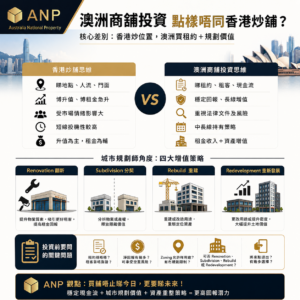
Ordinary buyers typically look at factors like school district, interior design, transportation, current rental income, and the apparent location when looking at a property. But urban planners look at factors like zoning, land area, frontage, entrances/exits, parking, drainage, overlays, easement, heritage, flood risk, and future development plans for the surrounding area.
On the same old plot of land, an average buyer might only see an old house; a planner, on the other hand, might see dual occupancy, subdivision, commercial conversion, rooming accommodation, or even different options such as preserving the existing building, repurposing its use, and increasing rental returns.
The true value of planners and buyer intermediaries
This is exactly ANP Planner x Buyer Agent The value of.
We don't simply find "cheap properties" for our clients, because cheap doesn't equal potential; nor do we blindly chase properties with approved DA (Authorized Domain Name) permits, because the value behind the permits may have already been realized by the sellers.
ANP's approach is to analyze land conditions from an urban planner's perspective before purchasing, including whether the existing use is legal, whether the development plan has a legal basis, whether the future application direction is reasonable, whether the costs and risks are controllable, and the difference in returns between different plans.
Only after obtaining DA Approval does the choice truly return to the buyer.
Investing in land with potential allows for more flexible decision-making. After purchase, buyers can work with planners to assess whether to apply for DA Approval; once approved, they can choose to continue development or resell to realize profits after the value has been realized.
The right to choose is the true value of an investment.
A property that has already been approved by the Development, Investment and Development Authority (DA) may be a clearer investment option; however, a large plot of land with existing housing that is not fully understood by the market but has a planning foundation may be a more worthwhile opportunity to study in depth.
When buying Australian property, don't just look at what's available today.
Therefore, the next time you see an Australian property ad that says "DA Approved," don't just ask, "Has it been approved?"
The more appropriate question should be: "Does this price already include the approved value?"
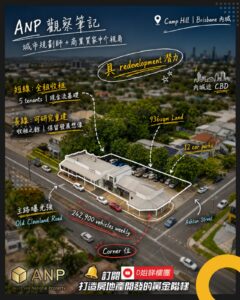
And when you see an old house, large lot, corner property, or main road property that hasn't been approved, don't rush to skip it. Real opportunities often lie in those plots of land that aren't fully understood by the market but have a planning foundation.
ANP, acting as both an urban planner and a buyer's agent, assists buyers in making clearer and more informed judgments in the Australian property market, covering aspects such as zoning, development potential, paperwork feasibility, and investment exit strategies.
When buying land in Australia, the most important thing is not just looking at what it has today, but figuring out what it can become tomorrow.
Want to know if a piece of Australian land truly has development potential?
ANP can provide you with pre-purchase analysis from the perspectives of urban planning, property search, paperwork feasibility, and investment strategy.




 Chinese