

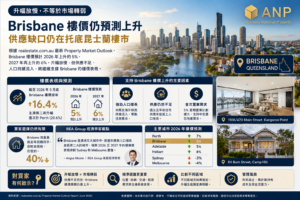
As we entered 2026, the Australian housing market showed a clear divergence. While house price growth slowed or even saw short-term corrections in many capital cities, Brisbane overwhelmingly emerged as one of the best-performing major cities in Australia.
According to the latest PropTrack Home Price Index, Brisbane's total residential property price increased by 14.61 TP3T over the past year, with the median house price rising by approximately AU$135,900 to around AU$1,013,000. This increase significantly surpasses Sydney's 6.41 TP3T and Melbourne's 4.51 TP3T, making Brisbane the fastest-growing market in terms of house prices among major East Coast cities.
From "Catch-up City" to Leading Market
From a long-term structural perspective, Brisbane's housing market has clearly moved away from its past positioning as a "relatively affordable alternative city." For the past decade or so, Brisbane's house prices have mostly lagged behind Sydney and Melbourne, but since the post-pandemic restructuring of population movement, employment patterns, and infrastructure investment, the city has gradually transformed into an independent, high-demand core market.
Latest data shows that Bristol's house prices have increased more than twice that of Sydney this year, and three times that of Melbourne. In absolute terms, the increase in asset value in a single year is enough to change the financial structure and home-buying strategies of many families.


Unit prices outperform detached houses, reflecting a shift in demand structure.
More noteworthy is the structural breakthrough in Brisbane's unit market in 2025. Unit prices rose by 18.31 TP3T year-on-year, exceeding the 13.51 TP3T increase for detached houses and overturning the decades-long market inertia of "units consistently underperforming detached houses".
This phenomenon reflects a fundamental shift in demand structure. As housing prices rise, market purchasing power is gradually shifting towards more affordable housing options. This, coupled with retirees reducing their living space, young professionals returning to urban areas, and interstate immigrants' preference for immediate occupancy, has all driven up demand for units.
From an urban planning perspective, medium-density housing in the inner city and near established transportation hubs is becoming one of the categories with the most limited supply and the most intense competition.
Prices remain under upward pressure amid interest rate uncertainty.
Despite widespread market focus on interest rate trends, multiple interest rate cuts in 2025 have already provided strong support for the housing market. Even with the risk of interest rate hikes in 2026, economists generally believe that their suppressive effect on housing prices will be offset by other structural factors.
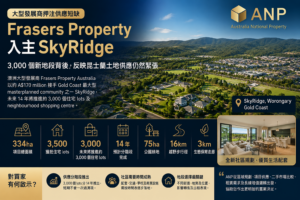
The most critical factor remains insufficient supply. Whether in Greater Brisbane or various regional markets in Queensland, the pace of new home construction has failed to keep up with population growth and the increasing demand from households. Coupled with high construction costs and lengthy planning approval cycles, new supply is unlikely to increase significantly in the short term.
In addition, the Australian government's ongoing low down payment policy has created additional demand in the low-to-mid-priced market, indirectly pushing up the overall price level.

The price gap between regional markets and capital cities is narrowing.
The Queensland market also performed remarkably well. Over the past year, the overall increase in regional residential property prices was approximately 131 million US dollars, with the median price rising by about AU$100,000 to AU$790,000. More structurally significant is the fact that the price gap between detached houses and apartments in the region has narrowed considerably to about AU$21,000, well below the historically common 30-40% gap.
This trend indicates that the market's pricing logic for "residential type" is changing, with supply scarcity and immediate occupancy demand gradually replacing land area as the core pricing factor.
A clear distinction from other capital cities
Looking at monthly momentum, market divergence has further intensified. Latest data shows that Brisbane and Perth both recorded a month-on-month increase of 0.51 TP3T in December, while Sydney and Melbourne saw declines of 0.31 TP3T each. Although Adelaide led in monthly performance, its annual size and market volume still cannot compare with Brisbane.
Overall, Brisbane has joined Perth as one of the most dynamic capital cities in Australia, but Brisbane has broader structural support in terms of population size, economic diversification, and long-term urban development potential.
A professionally-driven buying strategy becomes a key differentiator in a competitive market.
As Brisbane's housing market enters a new phase of high growth and intense competition, home buying is no longer simply a matter of price negotiation or an immediate decision, but a strategic act requiring consideration of urban structure, supply conditions, and medium- to long-term planning. Market performance shows that relying solely on publicly available information is no longer sufficient to fully identify truly scarce residential options.
As a buyer's real estate agency with urban planners as its core, ANP's service focus is not on chasing short-term market trends, but on helping buyers understand "why certain locations and housing types can be continuously revalued in different market cycles" from the perspectives of land use, regional development, supply constraints, and the evolution of living functions.
Through systematic regional research, identification of off-market properties, and integration of transaction strategies, ANP helps clients reduce decision-making uncertainty in a highly competitive environment and complete purchases that align with their long-term residency or asset allocation goals more efficiently.


 Chinese