
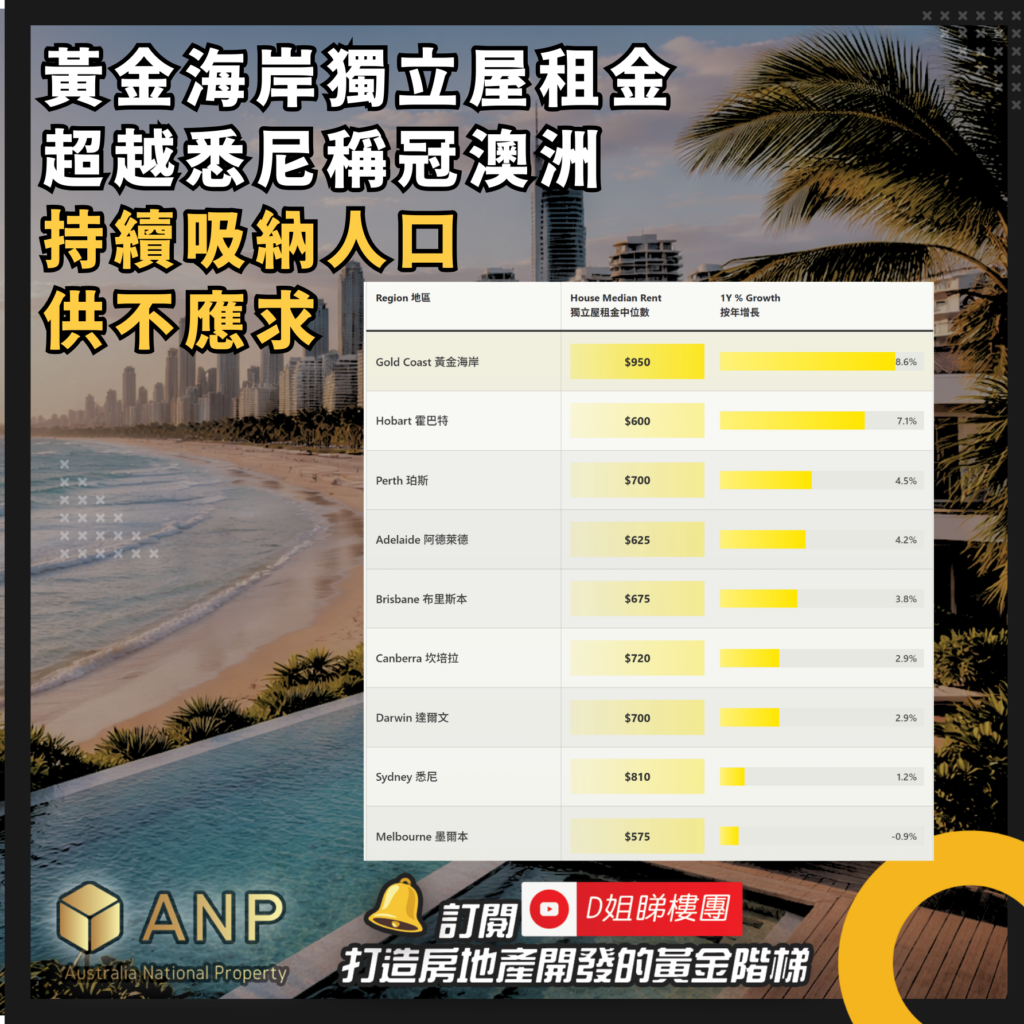
The Australian residential rental market is undergoing a significant transformation. Latest data shows that the median weekly rent for detached houses on the Gold Coast has risen to AU$950, surpassing Sydney's AU$810 and Melbourne's AU$575, making it the most expensive residential market in the country. Looking at the trajectory of Australian real estate development over the past decade, this shift is undoubtedly symbolic, reflecting that high-priced areas in the rental market are gradually expanding from traditional metropolitan areas to coastal cities with attractive lifestyles.
Contents Overview
ToggleResidential rents rise in major Australian cities
Median weekly rent for detached houses over a 12-month rolling period, compared to February 2026, January 2026, and February 2025.
| Region | House Median Rent Median rent for detached houses |
1M % Growth Monthly growth |
1Y % Growth Annual growth |
|---|---|---|---|
| Gold Coast | $950 | 2.2% |
8.6%
|
| Hobart | $600 | 0.0% |
7.1%
|
| Perth | $700 | 0.0% |
4.5%
|
| Adelaide | $625 | 0.8% |
4.2%
|
| Brisbane | $675 | 0.0% |
3.8%
|
| Canberra | $720 | 0.0% |
2.9%
|
| Darwin | $700 | 0.0% |
2.9%
|
| Sydney | $810 | 1.2% |
1.2%
|
| Melbourne | $575 | 0.0% |
-0.9%
|
The data was published by NEOVAL Research. Comparing major cities, the median weekly rent for detached houses is AU$700 in Perth, AU$675 in Brisbane, and AU$625 in Adelaide. The figures show that the Gold Coast not only rents more than the two major metropolitan areas on the east coast but also significantly outpaces other state capitals, indicating that its rent levels are no longer solely driven by tourism but are gradually reflecting a structural imbalance between supply and demand.
Ray White's chief economist, Nerida Conisbee, points out that the cost of renting between cities is widening rapidly. While the high-rent market was previously dominated by Sydney and Melbourne, some smaller, more attractive cities are now beginning to compete with, and even surpass, traditional metropolitan areas in terms of prices. This is not surprising when considering factors such as recent population flows, changes in work patterns, and a reshaping of housing preferences.
Residential demand remains high, but detached house supply has not expanded accordingly.
The Gold Coast's soaring rents, the highest in the country, are not solely due to superficial impressions like "sea views" or "resort atmosphere," but rather a combination of advantages. Firstly, Southeast Queensland has consistently attracted population inflows from interstate and overseas in recent years, keeping housing demand high. Secondly, post-pandemic housing preferences have shifted, with many families and professionals placing greater emphasis on living space, natural environment, and quality of life, transforming coastal cities like the Gold Coast from a previously selective market into mainstream destinations for homeownership and rental. Thirdly, while demand has increased, the supply of detached houses has not expanded proportionally, naturally driving up rents.
It's worth noting that the Gold Coast not only boasts high rent levels, but its rent increases have also outpaced the national average. Data shows that local house rents rose by 8.61 TP3T year-on-year, ranking first among major cities. In contrast, Sydney's year-on-year increase was only 1.21 TP3T, and Melbourne even recorded a slight decline. This reflects that while the Australian rental market has moved beyond the widespread surge seen in 2022-2023, the performance divergence between different regions has become more pronounced. Some cities characterized by both population inflows and tight supply continue to experience heavy rent pressures; while other previously high-priced markets have entered a more moderate consolidation period.
From a national perspective, the Australian rental market is currently more in a state of "consolidation at a high level" than "a comprehensive decline." According to Ray White data, the median weekly rent for detached houses across Australia is currently AU$650, and the median rent for apartments is AU$630, representing year-on-year increases of 4.81 TP3T and 4.21 TP3T respectively. While monthly growth has stabilized, this indicates more that the rapid increase is subsiding than that rental pressure has eased. The core issue behind the market remains the coexistence of limited supply and population growth, which prevents a significant drop in rents.
The unit market in Gold Coast is also at a high level.
In the housing market, the Gold Coast also maintains high levels. The median weekly rent for units there is AU$770, even higher than Sydney's AU$730; Perth's is AU$650, and Melbourne's is AU$580. This indicates that rental pressure on the Gold Coast is not limited to family-style detached houses, but has extended to all housing types, reflecting a fairly broad capacity to absorb rental demand in the area.
From a market evolution perspective, the Gold Coast phenomenon reflects a reshuffling of competitiveness among Australian cities. Sydney and Melbourne once monopolized high property prices due to their advantages in employment, education, and internationalization; however, as remote work, inter-regional mobility, and lifestyle factors have become increasingly important, some cities originally positioned as more leisurely have been able to attract middle- and high-income residents with their livability, environmental resources, and relatively mature urban functions, thus reshaping the rental market landscape.
For tenants, the Gold Coast boasts the highest rents in Macau, meaning it's no longer a relatively affordable coastal option, necessitating a readjustment of housing budgets. For landlords and investors, this reflects the resilience of rental demand in the area, particularly for residential properties with a high concentration of families, which still possess some bargaining power at this stage. However, persistently high rents may gradually suppress affordability, and whether the market can maintain its current level depends on the pace of supply release and the overall economic environment.
Overall, the Gold Coast surpassing Sydney and Melbourne to become Australia's most expensive residential rental market is not a simple cyclical fluctuation, but rather the result of a combination of factors including urban attractiveness, population mobility, and supply bottlenecks. For the Australian housing market, this is not merely a change in rental rankings, but a clear signal of a reallocation of capital, population, and lifestyles.
| Region | Median Rent for Detached Houses | 1M % Growth Monthly Growth | 1Y % Growth (Year-on-Year Growth) |
|---|---|---|---|
| Gold Coast | $950 | 2.2% | 8.6% |
| Hobart | $600 | 0.0% | 7.1% |
| Sunshine Coast | $800 | 0.0% | 5.3% |
| Perth | $700 | 0.0% | 4.5% |
| Adelaide | $625 | 0.8% | 4.2% |
| Brisbane | $675 | 0.0% | 3.8% |
| Canberra | $720 | 0.0% | 2.9% |
| Darwin | $700 | 0.0% | 2.9% |
| Sydney | $810 | 1.2% | 1.2% |
| Melbourne | $575 | 0.0% | -0.9% |
| Regional QLD (Remote Queensland Areas) | $675 | 2.3% | 7.1% |
| Regional TAS, remote areas of Tasmania | $480 | 0.0% | 6.7% |
| Regional NSW (Remote New South Wales Area) | $625 | 0.8% | 5.9% |
| Regional NT (Northern Territory Remote Areas) | $630 | 0.0% | 5.0% |
| Regional SA (Remote Areas of South Australia) | $450 | 0.0% | 4.7% |
| Regional VIC (Valley of Victoria) | $500 | 0.0% | 4.2% |
| Regional WA (Western Australia) | $650 | 0.0% | 3.2% |
| Australia | $650 | 0.0% | 4.8% |


 Chinese