
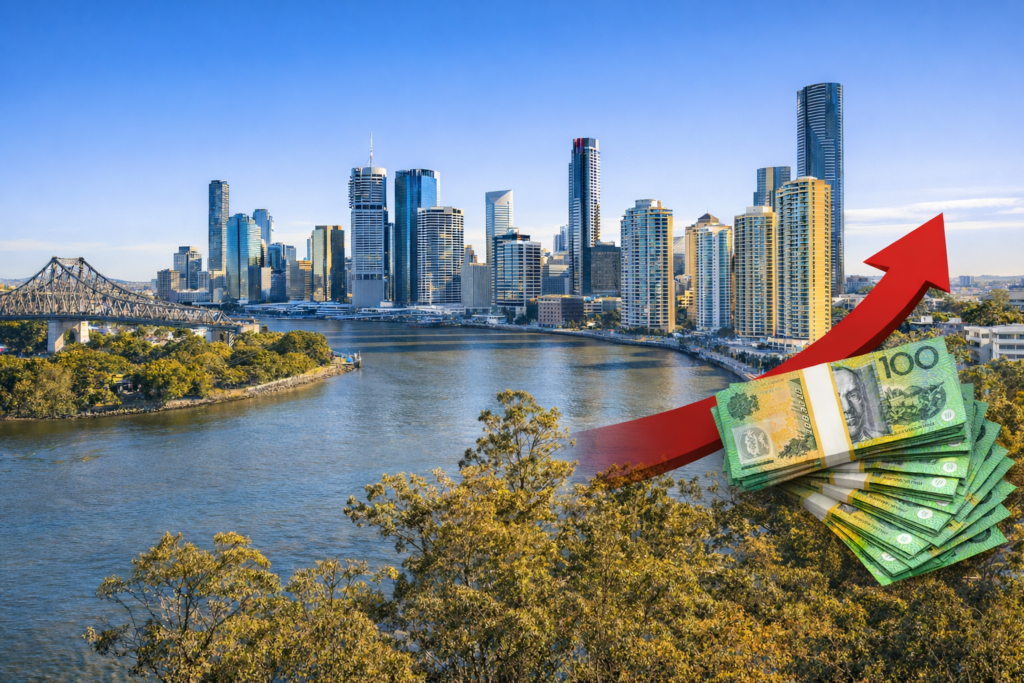
According to the latest PropTrack Home Price Index, Brisbane house prices continued their strong upward trend over the past year, with the overall median house price reaching AU$1.046 million, an annual increase of 15.9%. The apartment market performed particularly well, with an annual increase of 20.3%, reflecting a growing number of buyers turning to more affordable properties. For buyers looking at Brisbane real estate, Queensland property opportunities, or the direction of the Australian housing market, this data once again demonstrates that Brisbane remains one of the most promising growth markets in Australia.
Contents Overview
ToggleBrisbane house prices increased by AU$153,500 in one year.
According to reports, Brisbane house prices rose by AU$153,500 over the past year, equivalent to an average weekly increase of approximately AU$2,950. Latest data shows that Brisbane's median house price has reached AU$1.046 million, ranking second in annual growth among Australia's major capital cities, second only to Perth.
This not only signifies that Brisbane's housing market continues to experience high growth, but also further solidifies its key position in the Australian property market. For many buyers and investors, Brisbane is no longer just a cheaper alternative to Sydney and Melbourne, but a strong market with its own independent appeal.
Apartments are appreciating faster than detached houses.
In this round of price increases, apartment prices have outperformed detached house prices. Data shows that the median apartment price in Brisbane has risen to AU$831,000, an annual increase of 20.3%; while the median detached house price has reached AU$1,203,000, an annual increase of 14.7%.
This phenomenon reflects a shift in market demand. After a prolonged period of rising detached house prices, some buyers have found them unaffordable and are therefore turning their attention to more accessible condominiums. Especially given the current high interest rates and persistent cost of living, condominiums are gradually becoming a realistic option for many first-time homebuyers, young families, and investors.
Why have Brisbane apartments seen higher price increases?
PropTrack senior economist Eleanor Creagh points out that it's quite reasonable for apartment prices to outpace detached houses. This is because after a prolonged period of rising house prices, the market typically experiences a clear "affordability shift," where buyers begin to move from high-priced homes to more accessible properties.
She stated that the more affordable price range is currently attracting significantly more demand, with many people being pushed towards more affordable options. In other words, the surge in apartment prices is not solely due to increased investment demand, but also because the overall market has forced buyers to readjust their choices.
The core drivers of Brisbane's booming housing market: insufficient supply and strong demand.
Besides the shift in buyer budgets, the biggest reason for the continued rise in Brisbane house prices remains the imbalance between supply and demand. The report points out that there are still relatively few properties for sale on the market, but buyer demand has not weakened significantly, creating a situation of "tight supply and strong competition".
Especially in areas close to the city center, with convenient transportation, established school districts, and complete living amenities, any high-quality new developments or renovated, move-in ready homes launched on the market often quickly attract the attention of multiple buyers. This persistently tight supply is the main driving force behind Brisbane's continued price increases.
Cities surrounding Greater Brisbane also saw price increases across the board.
Not only did Brisbane's city center perform strongly, but surrounding cities also saw double-digit growth over the past year. Data shows that Ipswich saw a 19.7% year-on-year increase in house prices, with a median price of AU$881,000; Logan–Beaudesert saw a 19% increase, with a median price of AU$917,000; Toowoomba saw an 18.2% increase, with a median price of AU$779,000; and Moreton Bay saw a 17.6% increase, with a median price reaching AU$1,056,000.
This shows that the growth of Greater Brisbane is not just a single point of increase in the core area of Brisbane, but a synchronous expansion of the entire neighborhood. As prices in Brisbane's inner city rose rapidly, many buyers began to turn their attention to the outer areas, but with increasingly mature living conditions, hoping to acquire larger land, newer houses, and more complete family living spaces within their budget.
Why are buyers turning to Ipswich, Logan, and Moreton Bay?
For families, the biggest attraction of the outer suburbs is their relative affordability and the potential for a higher quality of life. Compared to Brisbane's inner city, Ipswich, Logan, or Moreton Bay often offer buyers newer homes, larger lots, and more spacious living areas at lower prices.
Furthermore, with the continuous improvement of local infrastructure, schools, retail facilities, and transportation connections, these areas have gradually transformed from spillover markets into satellite cities with their own appeal. For many, living around Greater Brisbane no longer means having to rely heavily on the city center every day, but rather achieving a balance between work, life, and family arrangements locally.
The high-end market is also heating up.
Besides the mid-priced market, Brisbane's high-end residential market has also gradually attracted attention in recent years. Ray White senior data analyst Atom Go Tian pointed out that the performance of some high-priced areas in Brisbane has begun to compete with the high-end markets in Sydney and Melbourne.
Locations like New Farm are gradually rising to the top of the list of luxury residential developments. This shows that the story of Brisbane's housing market is not simply about "relatively affordable prices," but rather that the market itself is developing towards greater maturity and higher value. For high-net-worth buyers, Brisbane is increasingly becoming a worthwhile consideration for asset allocation and long-term holding.
The 2032 Olympics and regional development are supporting market confidence.
Market analysts believe that the infrastructure development and long-term urban development expectations brought about by the 2032 Brisbane Olympics are also important factors supporting the housing market. As the connections between Brisbane, the Gold Coast, and the Sunshine Coast strengthen, the entire Southeast Queensland lifestyle area is expanding, further enhancing the overall attractiveness of Greater Brisbane.
This growth may not be fully reflected in prices in every area in the short term, but it is indeed changing buyers' expectations for the future. When people believe that a city will continue to invest in transportation, construction, employment, and lifestyle facilities over the next decade, the real estate market is more likely to gain long-term support.
Will interest rate hikes affect the Brisbane housing market?
While the market remains strong, interest rate trends remain the most noteworthy variable for the future. Eleanor Creagh points out that a single rate hike may not immediately reflect changes in house prices within a month, but if further rate hikes occur, the market outlook could change.
She believes that the rate of house price growth may slow down in the future, and the performance will become increasingly uneven across different areas. In other words, the Brisbane housing market may not reverse immediately, but it is likely to gradually move from a general price increase to a new phase of "regional differentiation and product differentiation".
Queensland's housing market as a whole still outperforms the rest of Australia.
Besides Brisbane and surrounding cities, house prices in regional Queensland also rose by 13.4% over the past year, with the median price reaching AU$810,000. In comparison, national house prices increased by 9.1% annually.
This means that whether it's the Brisbane core area, the Greater Brisbane metropolitan area, or other parts of Queensland, the overall performance is significantly stronger than the national average. From a national perspective, Queensland remains one of the states with the strongest housing market momentum, and Brisbane is undoubtedly its most representative and focal city.
Is it still possible to enter the venue now?
For many buyers, the real question may no longer be whether Brisbane house prices will continue to rise, but rather which areas and product types still offer both affordability and growth potential.
If you prioritize downtown living, good schools, and convenient transportation, then the scarce supply of inner-city properties still offers value. If you're more concerned with budget, space, and medium- to long-term development, then the cities surrounding Greater Brisbane are still worth exploring. As for investors, they need to make more precise judgments about which areas will benefit from infrastructure development, population inflows, and improved living standards in the future, rather than simply chasing the price increases of the past year.
In conclusion, Brisbane's housing market remains one of the most closely watched sectors in 2026.
Brisbane house prices rose 15.9% in a year, with the median house price exceeding AU$1.046 million. Apartments saw an even higher increase of 20.3% year-on-year, becoming a market highlight. From tight supply and buyers shifting towards more affordable products, to the full-scale expansion of Greater Brisbane, and the long-term confidence brought by the Olympics and infrastructure development, this wave of house market growth is clearly not caused by a single factor, but rather the result of multiple conditions working together.
For buyers, families, and investors researching Brisbane real estate, it is now more important than simply looking at market trends, but rather finding the location that best suits their budget, lifestyle needs, and long-term strategy.


 Chinese