
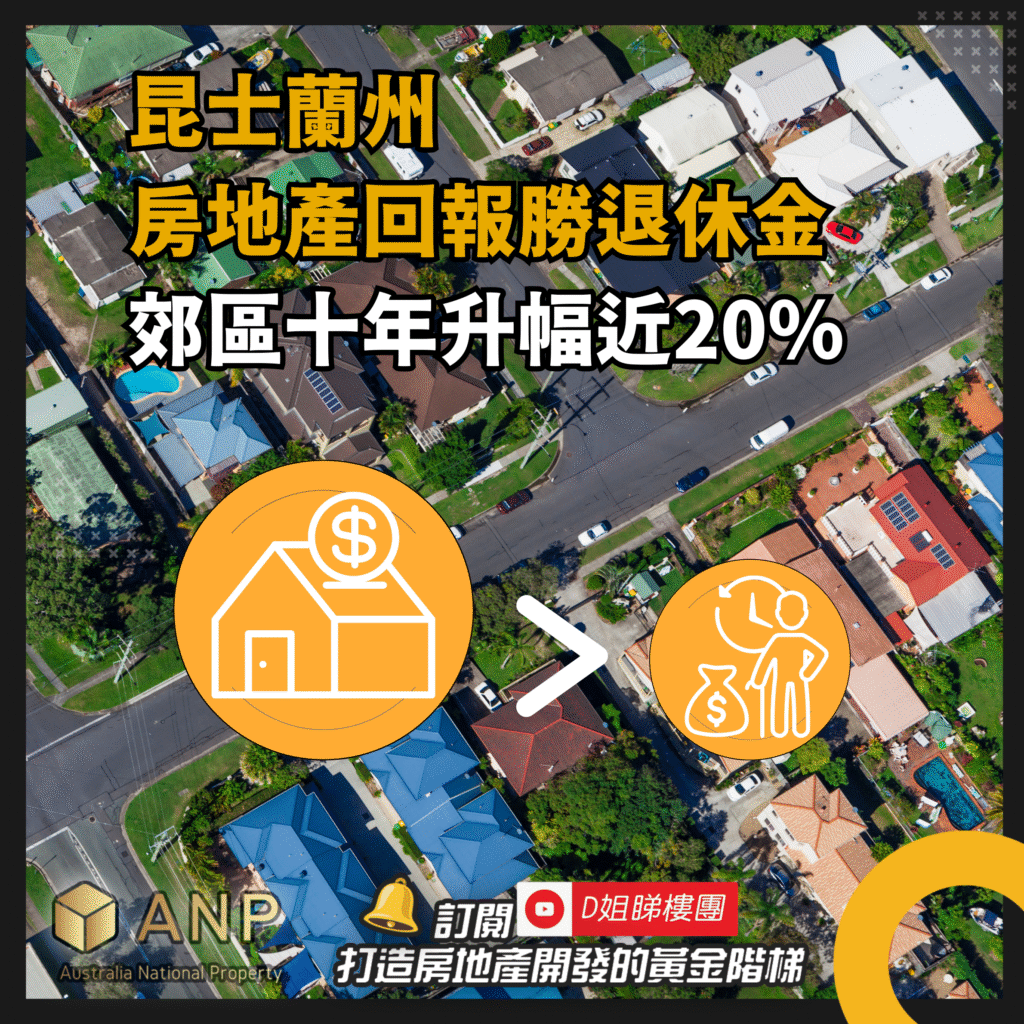
In Australia, buying a property isn't just a residential option; it's considered the ultimate investment by many families. However, as retirement systems mature, experts are increasingly encouraging residents to leverage their superannuation plans for steady growth. So, in terms of long-term returns, which is better, real estate or superannuation? A recent comparative study provides concrete data and insights for investors.
Contents Overview
ToggleReturns over the past decade: Property slightly outperforms superannuation, but significant differences exist across states
According to data from financial information platforms and real estate websites, the average annual return of Australia's superannuation funds over the past decade was 5.7%, while the average annual return of residential properties in Brisbane during the same period was 5.9%, slightly higher.
As for other cities, Hobart, the capital of Tasmania, performed the best, with an average annual increase of 6.9%, and Adelaide, South Australia, also recorded an increase of 6.7%. These areas, with their lower starting prices and increasing influx of people, have become new favorites for real estate investors.
Some areas of Queensland are booming: annual value-added rates are as high as nearly 20%
Further analysis of regional data reveals that the Queensland town of Beachmere has seen average house price growth of 19.21 TWh/3T over the past decade, the highest in the nation. Brisbane suburbs such as Chandler, Robertson, and Anstead have also recorded average annual increases exceeding 101 TWh/3T. These areas are often low-density, family-friendly communities, attracting investors as a result of outward population migration and infrastructure improvements.
However, experts also remind that high value-added is often accompanied by risks and instability, and investors must conduct in-depth research on local economic development and long-term planning.
High-growth pension strategies: winning through stability and outperforming expectations
If we only look at a general balanced retirement plan, its return of 5.7% may not be eye-catching. However, a retirement account that chooses the High Growth Option can achieve a total return of 157% over the past decade, which is equivalent to an average annual growth of approximately 9.1%, exceeding the average house price increase in Australia (approximately 6.5%).
The study also pointed out that this type of high-risk, high-return pension product performs outstandingly under professional management and is particularly suitable for young and middle-aged employees who want to invest for the long term and are not in a hurry to cash out.
Unit market returns far lag behind detached houses: only 50% increase
Notably, Australia's apartment market has underperformed significantly compared to its house market. Over the past decade, the overall unit price return has been a mere 50.4%, indicating pressure on both rental returns and capital appreciation. Analysts believe that the oversupply of high-density properties in cities like Sydney and Melbourne, coupled with declining demand from international buyers, is one of the main factors suppressing the unit market.
Retirement and property investment: Combining strategies is becoming increasingly popular
A mortgage advisor noted that more and more self-employed individuals are choosing to purchase property through a Self-Managed Super Fund (SMSF). She said, "Many businesspeople are using SMSFs to invest in commercial or even residential properties as part of their asset allocation, often under the guidance of an accountant or financial advisor."
However, when operating SMSF investment properties, one must pay attention to regulatory restrictions, including prohibitions on self-residence or renting to relatives. Violations may result in heavy penalties.
High pensions face new tax challenges
The federal government has implemented a new tax system, imposing an additional 15% tax on superannuation account assets exceeding A$3 million. Although it only affects about 80,000 high-asset individuals, the industry is generally worried that as inflation pushes up asset values while the tax threshold remains unchanged, more middle-class people will be included in the scope in the future.
Financial experts said, "Without an adjustment mechanism, this 'rich tax' could become a disguised tax on the middle class."
Both have their own advantages and should be tailored to the individual.
The above data suggests that real estate has strong appreciation potential in certain regions, while retirement funds offer relatively stable, tax-free or tax-deferred income. Experts generally recommend that investors diversify their portfolios based on their age, risk appetite, liquidity needs, and retirement goals.





 Chinese