

Australian real estate research firm PropTrack, in collaboration with environmental data platform Ambient Maps, has released a world-first report quantifying the actual impact of traffic noise on property prices. The results show that homes near airports, busy arterial roads, or railways can cost up to 181,000 TWD less, on average, than homes in quieter areas. However, experts warn that noise, in addition to depressing property values, can also negatively impact health, learning, and rental stability.

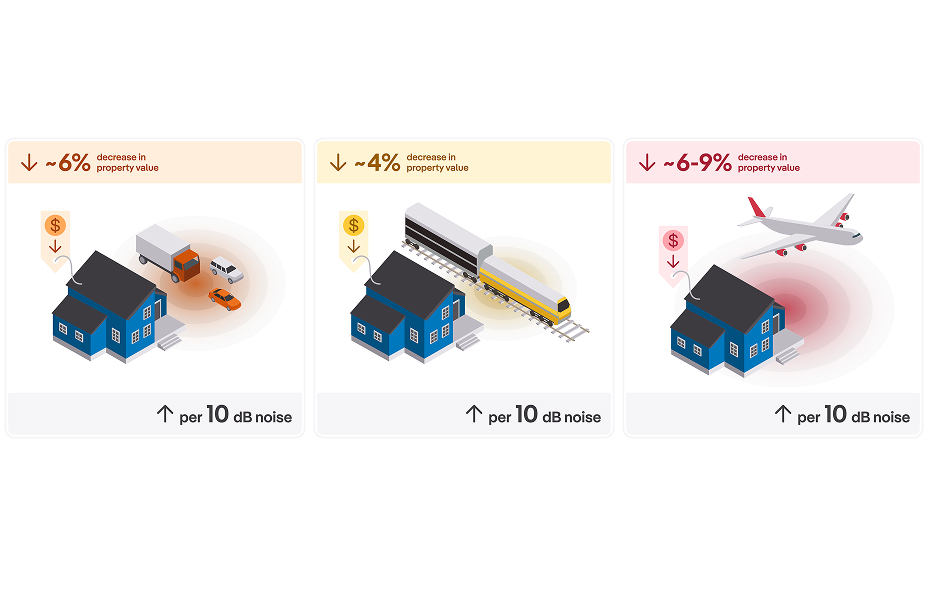
Airport flight paths have the greatest impact, with property prices dropping by 6-9% for every 10dB increase.
The report analyzed valuation models for 3.7 million properties in Victoria, combined with real-time noise simulation data for every building unit nationwide. It found a significant negative correlation between traffic noise and property values. Aircraft noise had the greatest impact, with a 10-decibel increase in property values resulting in an average decrease of 61 to 91 TP3T. For homes located directly under a shipping lane, where noise levels can be up to 20 decibels higher than typical residential properties, property values can be as much as 121 to 181 TP3T lower than those in noise-free locations.
The research team modeled 3.7 million residential units in Victoria, covering noise data during daytime, dusk, and nighttime, and analyzed 150,000 buildings and over one million kilometers of road and rail networks. The results showed:
- Every 10 decibelsaircraft noiseThe average house price fell by 6% to 9%;
- road noiseFor every 10 decibels, property prices fall by 6%;
- Railway noiseIt fell by 4%, with freight railways being the most affected.
The study also pointed out that the impact of nighttime noise on property prices is particularly significant, reflecting the public’s high emphasis on the quality of life during “quiet nights”.
“Quietness has a price”: Buyers are willing to pay a premium for quiet areas
Kevin Ward, data director at PropTrack, noted that properties in quieter areas generally hold higher value, indicating buyers are willing to pay a premium for a peaceful living environment. "Noisier homes may offer a more affordable entry point for first-time buyers, but the potential for value growth and the health risks must be considered."
"Close but not noisy" is the ideal location. Whether the window faces the road is the key to valuation.
Ben Hinze, Director of Ambient Maps, noted that this simulation not only covers the buildings themselves but also details the noise exposure of each building's different facades on each floor, resulting in the most accurate valuation variation model. "In the same building, if the master bedroom faces a busy road or railway, the valuation can differ significantly from that of one facing an inner street."
Hinze added that not all locations with convenient transportation are devalued due to noise. A location that's "close but not noisy," such as one across the street from a tram stop, offers both commuting convenience and a quiet lifestyle, making it an ideal property investment.
High-end buyers in quiet areas are more concerned about narrowing the gap in hot markets.
Sydney real estate agent Nathan Lang shared that in the airport-adjacent areas he serves, such as Mascot and Botany, some buyers are willing to tolerate aircraft noise in exchange for the advantage of being close to the city, but buyers of high-priced homes generally have a lower tolerance for noise.
“When buyers have a higher budget, they can choose not to compromise and be more concerned about street busyness. However, when the market is hot and there are fewer options, the price gap between quiet and busy streets narrows significantly.”
He also reminded property owners affected by the waterway to avoid overcapitalising when renovating or adding to their properties, as the price of their properties after upgrading may not reflect the cost of the improvements.
Noise not only affects property prices but also affects health and educational development.
Noise impacts health and rental stability: ESG inclusion in real estate valuations is a new trend
The study also focused on the impact of traffic noise on residents’ physical and mental health and community sustainability. The report cited data from the World Health Organization, stating thatNoise pollution is the second largest environmental health risk after air pollution, long-term exposure is closely related to cardiovascular disease, sleep disorders and learning disabilities in schoolchildren.
In addition, the tenant churn rate for rental properties in areas with excessive noise levels is 69% higher than in other areas, reflecting the risks it poses to rental stability and investment returns.
In addition, a 2019 study also found that rental properties with noise levels exceeding WHO standards had a tenant churn rate 69% higher, reflecting the close correlation between noise and rental stability.
Infrastructure brings convenience but also creates risks, requiring a balance of considerations.
The report concludes that while infrastructure projects such as highways, railways or airports can improve regional accessibility and benefit property values in the long run, the associated noise pollution can become a double-edged sword, undermining residential appeal.
“As urban density continues to increase, planners and investors need to better understand the potential long-term impacts of noise on residential values and health.”
In this new trend, the role of urban planners is becoming more crucial than ever. For example, our real estate consulting team, ANP, boasts a multidisciplinary perspective, enabling them to effectively analyze government infrastructure development plans, future noise-sensitive area demarcations, road and rail expansion plans, and their potential impact on the property market. They also integrate these plans with local lifestyles and the needs of international investors to develop forward-looking real estate strategies.
Many Hong Kong or Taiwanese buyers new to Australia struggle to determine whether a particular area is susceptible to noise, or mistakenly assume that proximity to a railway is a positive factor, overlooking the risks associated with noise and turnover. ANP's team of urban planners can help clients balance the delicate trade-offs between price, convenience, and health based on real-world noise models, transportation accessibility, and community resources. This approach is particularly suited for buyers seeking mid- to long-term residential or stable investment opportunities.
Furthermore, with numerous infrastructure projects imminent in Australia, including light rail extensions, airport expansions, and highway expansions, a team that understands how to anticipate noise fluctuations and plan accordingly will be crucial for investors in maintaining property value. Cities are not static, and choosing a team that adapts to these changes can better secure long-term value than simply purchasing at a low price.


 Chinese