
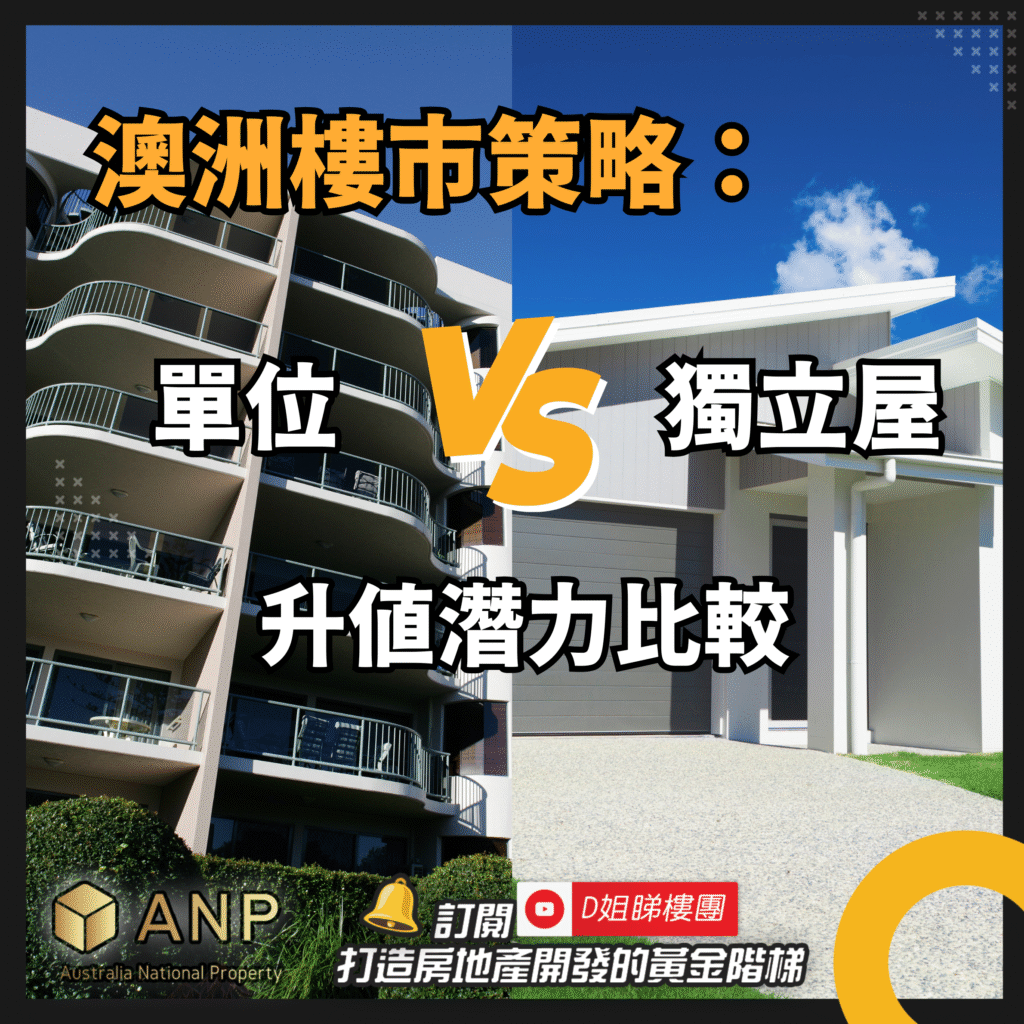
With the recent rebound in the Australian property market, first-time buyers, immigrant families, and return-focused investors alike face a fundamental and crucial question: should they invest in an apartment or a house? For many Hong Kong residents, in particular, Australian property is not just a component of asset allocation but also a vital component of lifestyle and family development. This article examines both short-term and long-term investment strategies, attempting to clarify strategic direction.
Contents Overview
ToggleShort-term deployment: units have entry advantages and rental returns
For investors seeking a stable cash flow in the short term or with limited funds, units are becoming increasingly attractive. Since 2024, several Australian states have actively promoted medium- and high-density housing policies, relaxing planning restrictions and boosting the supply of new unit projects. These new developments emphasize open-plan designs, light and ventilation, and smart home features, significantly addressing the public's previous negative perception of cramped units.
According to data, even in prime areas of Brisbane such as Ascot and Newstead, the median price gap between detached houses and units exceeds 60%, but the rental return rate of many unit projects is more impressive, which has become a reason for many buyers to enter the market.
According to forecasts, Australian unit prices are expected to increase by approximately 4.61% per 3T in 2025, outperforming the 3.31% per 3T increase for detached houses. Considering both cost and expected appreciation, units are becoming a popular choice for investors seeking short-term returns.
Long-term strategy: Detached houses maintain land dividends and capital appreciation
From the perspective of long-term asset appreciation and generational inheritance, the appeal of detached homes is undeniable. Since 2020, the cumulative price increase for detached homes in Australia's capital cities has reached 33.91T/3T, far exceeding the 11.21T/3T for units. The fundamental reason for this disparity lies in the value of the land.
With limited land supply and continued strong demand in suburban areas, coupled with population growth and infrastructure development, detached homes have promising long-term capital appreciation potential. Furthermore, detached homes offer greater spatial flexibility, allowing for expansion, reconstruction, and re-division, increasing asset utilization, a feat difficult to achieve with units.
However, these properties are typically more expensive, with increased barriers to entry and holding costs, making them not suitable for all investors. They are more like a "savings" asset, requiring time to generate returns.
Risks and limitations: Choose carefully when buying a unit; detached houses aren't always the answer.
It's worth noting that while unit investment offers the advantages of high rental returns and low barriers to entry, it also carries potential risks, such as the market supply risk of high-density projects, building management fees, and the difficulty of resale due to varying construction quality. Therefore, selecting a reputable developer and reviewing the Owners' Committee minutes (BCM minutes) are essential steps before purchasing a unit.
In contrast, although detached houses have the advantage of land, they face higher repair and maintenance responsibilities and need to manage rental matters themselves, which places higher demands on investors' resources and time.
Choose the right real estate strategy based on time
The essence of property investment isn't just about chasing short-term profits; it's also about long-term lifestyle planning and risk management. If your goal is to generate rental income within three to five years, a property with stable rental demand and a robust management system is a logical choice. If you prioritize asset appreciation and spatial flexibility and are willing to invest more resources in long-term ownership, the potential of a detached house shouldn't be overlooked.


 Chinese