

The Australian property market demonstrated remarkable resilience in 2024. Despite economic challenges and a low Australian dollar, the real estate market and property prices continued to rise steadily, with cities such as Perth, Adelaide, and Brisbane showing the strongest performance. According to Domain's latest "2024 Year-End Property Market Review and 2025 Outlook," four key areas will shape the market's development in the coming year.
Emerging cities are on the rise, with Brisbane, Perth and Adelaide performing particularly well.
Traditionally, Sydney and Melbourne have dominated the Australian real estate market, but a series of economic factors have shifted the market's focus in 2024. Cities such as Brisbane, Adelaide and Perth have performed strongly this year, with significant increases in house prices. Domain predicts that the median house prices in Brisbane and Adelaide are expected to exceedAUD 1 millionThe house price in Perth will also gradually approach this level.
The rise of second-tier cities is driven by a variety of factors, including relatively low local property prices, stable regional economic growth, and increasing interstate population inflow. Furthermore, the lifestyle and work opportunities offered by these cities have attracted buyers seeking a "tree-side lifestyle" and a change of pace.
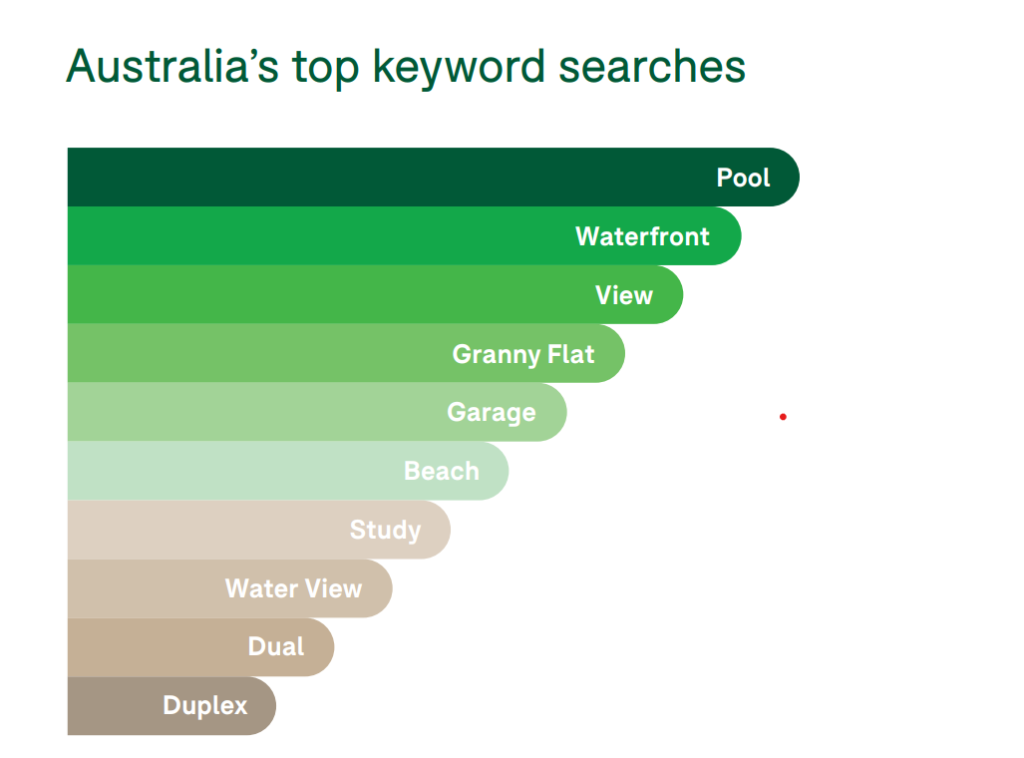
Property search trends reflect changing demand: "Waterfront" properties surge in popularity, while "study" properties plummet.
Despite rising property prices, Australian buyers are still pursuing quality of life, which is reflected in the "very honest" online property search trends. Let's take a look at the key words in the Australian property market.
Swimming pool demand tops the list
"Pool" has been the most searched keyword for two consecutive years.No. 1 in the country, demonstrating buyers' pursuit of an elevated quality of life in their homes. Following the pandemic, more people are opting for leisure facilities at home, with swimming pools becoming a symbol of aspirational living. Furthermore, with the regional real estate market booming, many buyers are choosing to move to larger homes, many of which feature private pools or the potential for expansion, further driving demand for pools.
Waterfront properties are gaining popularity
Waterfront properties, ranked second, climbed from fourth place in 2023 to second place in 2024, reflecting a growing preference among Australian buyers for quality environments and natural landscapes. For many buyers, waterfront homes not only symbolize an improved quality of life but also offer a long-term investment. This is particularly true in cities with a slower pace of life, such as Brisbane, Adelaide, and Perth, where waterfront properties have become a key selling point for interstate relocation.
Demand for study rooms has declined significantly
Search interest for "study" has plummeted from second place last year to seventh place. This shift is closely tied to shifts in work patterns. With the post-pandemic economic recovery and the trend of re-shoring, more companies are requiring employees to return to the office, while the proportion of people working from home has decreased, leading to a decline in demand for dedicated study spaces.
Demand for grandma's house remains stable
Granny Flat remains at fourth place, indicating that the market isFlexible residential spaceThe popularity of granny houses is mainly driven by several factors:
- Tight rental market: The grandmother's house can be rented out, bringing the owner a stable side income and alleviating mortgage pressure.
- Multi-generational living needs: With the shortage of housing supply and changes in family structure, more and more families choose to live with their elders or adult children. Granny flats provide independent living space.
- Flexible space usage: The granny flat can be used as an office, studio or storage space, meeting the buyer's demand for flexible living mode.
Other popular search trends: Practicality and investment are equally important
In addition to properties with swimming pools and waterfront views, buyers also pay attention to practicality and investment potential when searching online.Double parking space、Solar equipmentandAmple storage spaceSearch interest in properties has also increased. This reflects that buyers are increasingly valuing the long-term functionality and energy efficiency of properties. In particular, with the rising cost of living, homes with sustainable designs are becoming more attractive.
Regional and luxury housing demand is polarized
It's worth noting that while demand in the traditional luxury market remains stable, regional real estate markets are seeing a gradual increase in search interest, reflecting a growing trend among buyers seeking a "tree-side lifestyle" or a change of scenery. These areas offer relatively lower prices and more spacious living, attracting buyers seeking an improved quality of life.
Property prices continue to rise under economic pressure
Inflationary pressures, rising living costs, and stable interest rates have not dampened the performance of the Australian property market. A chronic housing shortage, coupled with high construction costs and labor shortages, has led to a supply-demand imbalance in the market, which continues to support rising property prices. Furthermore, Australia's robust population growth has further fueled housing demand, particularly in cities with high influx of immigrants, making it difficult for property prices to fall.
Domain Group points out that this structural problem of supply shortage is long-standing and cannot be resolved in the short term. By 2024, the growth momentum of national house prices will gradually shift to secondary cities such as Perth, Adelaide and Brisbane, breaking the previous situation where Sydney and Melbourne were the only ones to perform well.
Four major real estate market focuses in 2025
1. Interest rate cuts become a key market variable
With buyers' purchasing power constrained by high interest rates, the Reserve Bank of Australia's (RBA) interest rate cuts will be a significant driver of the property market in 2025. Domain predicts that the property market will maintain low growth in the first half of 2025, but will rebound in the second half of the year with the potential for lower interest rates. Furthermore, if the government relaxes the mortgage stress test, it will help improve buyers' borrowing capacity and further boost the property market.
2. Federal election focuses on housing policy
Real estate policy will be a major campaign issue in the 2025 Australian federal election. Policies such as incentives for first-time homebuyers, negative gearing reforms, a shift from stamp duty to land tax, and incentives for affordable housing are all likely to be introduced. These policy changes will directly impact market demand, buyer confidence, and property price trends, particularly in the first-time homebuyer and investor markets.
3. Promote urban density
With the continued population growth of Sydney, Melbourne, and Brisbane, the need for urban density in Australia is inevitable. Governments will intensify their efforts to promote medium-density housing, including clusters of villas and small apartments in middle-ring areas, to meet the needs of young families and retirees. Furthermore, changing family structures, such as multi-generational living and shared living, will drive demand for flexible residential space.
4. Green homes become the new normal
Rising energy costs and growing environmental awareness are driving the popularity of energy-efficient homes. Properties featuring solar panels, battery storage, and thermal insulation are increasingly popular among buyers. Furthermore, government subsidies and mandatory energy ratings are further driving the green housing market. Domain notes that properties with sustainable designs not only save on energy costs but also have the potential to maintain and increase their value over the long term.
Market Outlook in 2025
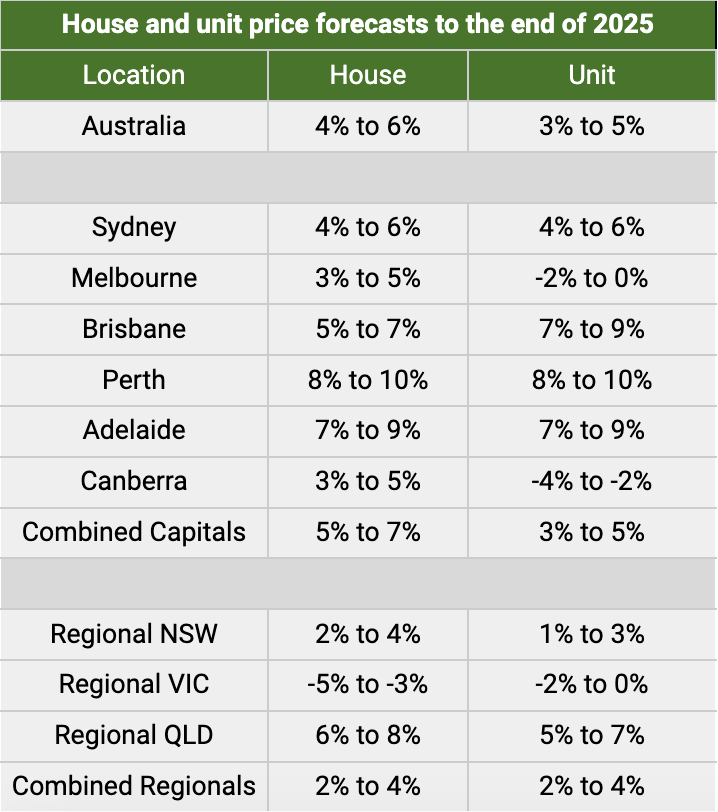
According to the latest Domain report, house and unit prices in major Australian cities and regions will show different trends, with some markets maintaining strong growth while others face growth pressure. Below is a detailed analysis and forecast for each city:
Sydney: Solid growth, but affordability remains a challenge
- detached house: Expected growth 4% to 6%
- unit: Expected growth 4% to 6%
Demand remains strong in Sydney, the heart of Australia's real estate market. However, high prices and mortgage affordability are putting pressure on first-time buyers. Buyers are increasingly turning to medium-density housing, such as small apartments or duplexes, in the city's outer boroughs. Furthermore, continued strong demand for detached homes in some coastal areas and popular school districts is supporting price growth.
Melbourne: Unit market under pressure as growth slows
- detached house: Expected growth 3% to 5%
- unit: Expected to fall -2% to 0%
Melbourne's market is constrained by economic pressures and slowing population growth, particularly in the unit market, which has been impacted by weakening demand, leading some investors to exit. Furthermore, high interest rates have made buyers more cautious about high-priced properties. However, in the city's periphery, such as the middle ring, villas and duplexes remain relatively affordable, maintaining stable demand and supporting detached house prices.
Brisbane: Strong demand, unit market outperforms
- detached house: Expected growth 5% to 7%
- unit: Expected growth 7% to 9%
Brisbane's property market is driven by strong inward migration and interstate demand, particularly attracting families and investors seeking suburban living. The detached house market remains resilient, particularly in amenity-rich suburbs. Furthermore, as the impact of the 2025 Brisbane Olympics unfolds, infrastructure investment and economic development continue to drive property prices upward, with the unit market performing particularly well.
Perth: The fastest growing market in the country
- detached house: Expected growth 8% to 10%
- unit: Expected growth 8% to 10%
Perth is poised to be a bright spot in the Australian property market through 2025, with projected house price growth leading the nation. Relatively low property prices, coupled with a strong local economy and growing resources sectors, are attracting a large number of first-time homebuyers and investors. Perth's urban infrastructure development is also driving housing demand, particularly in areas surrounding the city center and near the water, which have become a focus of the market.
Adelaide: Steady growth in a small city
- detached house: Expected growth 7% to 9%
- unit: Expected growth 7% to 9%
Adelaide continues to attract interstate migrants with its high-quality living environment and relatively low property prices. The local economy is robust, and infrastructure development is supporting market demand, particularly for detached houses in the city, located near schools, hospitals, and other amenities. Furthermore, retirees and young families are increasingly turning to Adelaide, driving growth in the unit market.
Canberra: Market faces adjustment, detached houses are stable
- detached house: Expected growth 3% to 5%
- unit: Expected to fall -4% to -2%
As the federal capital, Canberra's property market is significantly influenced by the job market and government policies. While the house market remains stable, the unit market faces significant pressure, particularly from price corrections caused by oversupply and weakening demand. With the introduction of further government housing policies, the market is expected to gradually stabilize by 2025.
Summary: The housing market will be clearly differentiated in 2025
Australia's property market will be polarized in 2025:
- Regional cities such as Perth, Brisbane and Adelaide will continue to lead market growth, benefiting from increased demand driven by affordability and economic development.
- Traditional markets such as Sydney and Melbourne are facing slower growth, with the unit market in particular facing greater pressure.
Meanwhile, while regional markets are generally stabilizing, some areas, such as Victoria, will continue to face downward price pressure. Market trends in 2025 will depend on changes in interest rates, government policies, and housing supply. Investors should closely monitor market trends and invest in the market at opportune moments.
Sources: Domain's "2024 Year-End Property Market Review and 2025 Outlook" report





 Chinese