
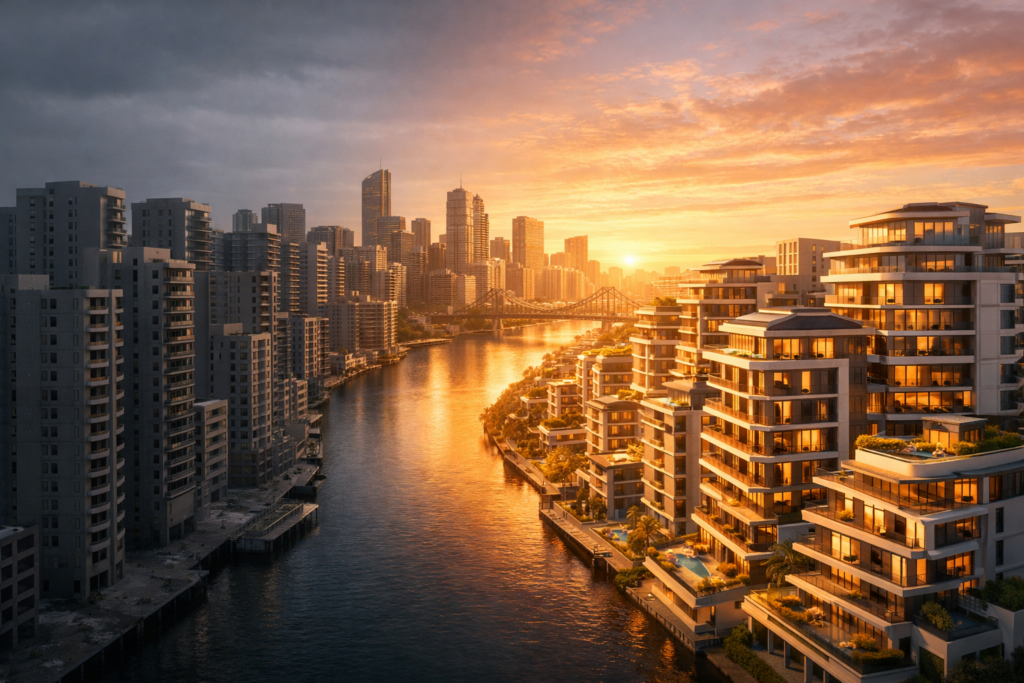
The Brisbane apartment market is witnessing a very typical and noteworthy reversal of the housing market cycle. Inner-city apartments, which had suffered from weak prices for many years due to oversupply, have not only escaped the slump but are even entering a phase of rapid price recovery. For buyers who are focusing on Brisbane real estate, Queensland apartment investment, or changes in the Australian residential market, this is not just the story of a single property, but a signal of a shift in the entire market structure.
Contents Overview
ToggleAccording to a report by The Courier-Mail on February 24, 2026, a one-bedroom apartment in Fortitude Valley nearly doubled in price in just three years, becoming a significant example of how Brisbane's apartment market has gone from oversupply to prosperity.
Fortitude Valley apartments nearly doubled in price over three years.
For example, a one-bedroom apartment in Fortitude Valley purchased for AU$301,000 in December 2022 sold for AU$600,000 in February 2026. The transaction result is that the price almost doubled in three years.
Such a surge is not just an isolated, astonishing case in the Brisbane apartment market, but rather a microcosm of it. Real estate agents point out that this address almost perfectly encapsulates the cycle of the Brisbane apartment market over the past decade: first, a significant increase in supply and downward pressure on prices; then, a period of low market confidence; and finally, a rapid recovery driven by supply contraction and rising demand.
Brisbane apartments have long been hampered by oversupply.
Looking at a longer timeframe, these inner-city apartments haven't always performed strongly. The report notes that this particular property sold for AU$386,460 during the 2011 development boom, but by 2018, when the supply glut was at its worst, the price had plummeted to AU$242,000.
This history perfectly reflects the typical problems in Brisbane's inner-city apartment market between 2014 and 2018. At that time, a large number of new projects were completed simultaneously, with supply exceeding actual demand, leading to a decline in investor confidence, generally putting downward pressure on prices, and causing many buyers to have doubts about apartments. In contrast, detached houses have performed much better in terms of capital appreciation over most of the past decade, while apartments have significantly lagged behind.
Why are Brisbane apartment prices starting to surge?
Market experts believe that this surge is not simply speculation, but rather a structural correction. This price change reflects not speculation, but a natural consequence of the market completing a cyclical reversal.
A real estate agent pointed out that the past period of oversupply led many buyers to deliberately avoid apartment properties for years, but the situation is now completely different. The market is now tight with low vacancy rates, and buyer sentiment has changed significantly. Simply put, the risk factors that deterred buyers in the past are disappearing, while new supporting factors are gradually forming.
From this perspective, the recent strength of Brisbane's apartment market can be understood to some extent as "growth that was delayed for many years is being made up for in a shorter time."
The price increase in apartments is due to their lagging performance over the past decade.
Real estate agents further pointed out that during years of oversupply, apartments did not actually enjoy the typical "doubling in value over ten years" pattern common in the real estate market. In other words, while detached houses continued to appreciate in value, the apartment market stagnated or even declined due to inventory pressure.
What the market is seeing now is the concentrated release of that pent-up growth in a relatively short period of time. This also explains why some previously overlooked inner-city apartments in Brisbane are now experiencing significant price jumps.
This catch-up rally is particularly noteworthy for investors because it signifies that the market is no longer solely reliant on short-term sentiment, but rather built upon a substantial foundation established after years of correcting supply and demand imbalances.
The supply and demand relationship in Brisbane's apartment market has reversed.
Other industry insiders have also pointed out that the biggest change in Brisbane's apartment market today is that the supply and demand relationship has been completely reversed. In the last cycle, the supply of new residential properties exceeded the demand driven by population growth; but now, while the population of Southeast Queensland continues to increase, the supply of new developments is not as abundant as it was a decade ago.
In other words, when demand is still rising and the development pipeline is no longer so large, the market is naturally more likely to enter a state of tight supply. This structure is particularly advantageous for already built, well-established inner-city apartments.
Especially in areas like the Brisbane inner ring, which are close to the city center, have mature amenities, and convenient transportation, existing residential inventory is more likely to be favored by buyers and renters. For many first-time buyers and investors, these properties are usually more affordable than inner-city detached houses, while still enjoying relatively stable location value.
First-time homebuyers, investors, and construction costs all contribute to increasing the value of existing apartments.
The Brisbane apartment market is currently supported by more than one factor. Reports indicate that competition between first-time buyers and investors is intensifying, while rising construction costs are further limiting the supply of new homes, which in turn supports the value of existing apartments.
This is important. As development costs for new projects continue to rise, future apartment prices will be supported, making it harder for the market to return to the era of low prices and abundant supply. This makes completed, ready-to-move-in inner-city apartments even more attractive.
For buyers, this is not just about buying a living space, but about purchasing an asset with limited supply and rising replacement costs.
Immigration and rental demand continue to support the Brisbane apartment market.
With continued immigration from interstate and overseas, coupled with a shortage of new housing supply, rental demand in Brisbane is expected to remain high, and vacancy rates will remain low, further supporting rental yields.
Brisbane is gradually transforming from a livable Australian city into a more internationally attractive destination, and this shift in positioning will fundamentally change the entire real estate market.
This is particularly crucial for investors. New immigrants typically don't buy property immediately upon arriving in a city; instead, they rent first to familiarize themselves with the environment. Therefore, as long as net population inflow continues, rental demand usually remains strong. For the apartment market, this means both the rental and resale markets are likely to benefit simultaneously.
What does the Brisbane apartment market mean for buyers and investors?
Judging from current market conditions, the Brisbane apartment market is no longer the market that caused concerns about oversupply in the past. On the contrary, it is now more like a market with limited supply, increasing demand, strong rental support, and prices catching up.
For first-time homebuyers, inner-city apartments remain a relatively viable way to enter the Brisbane property market. For investors, low vacancy rates, stable rental demand, and emerging capital appreciation trends make these properties attractive again. As for sellers, they have the opportunity to secure more favorable transaction terms amidst increased competition from local and interstate buyers.
In conclusion, the Brisbane apartment market is no longer what it used to be.
The case of this apartment in Fortitude Valley nearly doubling in value in three years is not just a surprising individual case, but more like a clear signal: the Brisbane apartment market has completed its full cycle from oversupply to a boom recovery.
Brisbane's apartment market, which had long been sluggish due to oversupply and a lack of confidence, is now entering a new phase thanks to population growth, reduced development, low vacancy rates, and changing buyer sentiment. For those assessing Brisbane real estate opportunities, the question is no longer simply "Is it a good time to buy an apartment?", but rather "Which areas and which properties will benefit most from this structural turnaround?"
The content of this article is for general informational purposes only and does not constitute any legal, investment, or financial advice; individual cases should be discussed with professionals based on their specific circumstances.

 Chinese