
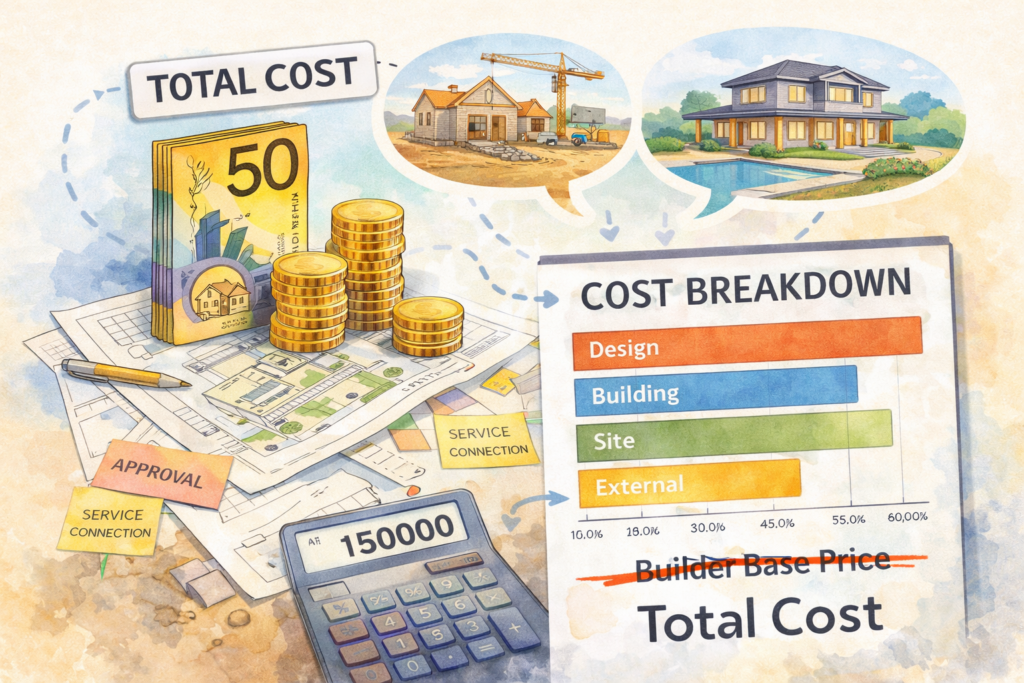
The biggest mistake many people make when budgeting for building a house is not the building price per square meter, but rather oversimplifying the entire project. The most common mistake is seeing a building price from the builder and instinctively assuming it's the "total cost of building the house." However, for custom builds or more complex residential projects, the base price is usually only one part of the overall cost, not the whole. Recent Australian building cost data repeatedly emphasizes that the building price per square meter only reflects a portion of the cost; a proper budget must include professional fees, site costs, external works, and other ancillary expenses.
The true total cost can often be broken down into several levels. The first level is the initial design and consulting fees. This may not be the most obvious, but it's often the first expense to be incurred. For custom builds, before construction even begins, the project may involve conceptual design, construction drawings, surveying, soil testing, structural engineering, cost estimation, and consultant coordination. These services are not optional extras; they are fundamental to whether the project can reach the stages of being constructible, quotable, and approved. Therefore, it's perfectly normal to incur a significant amount of upfront funding.
The second part, which many people are most familiar with, is the main construction cost, the actual building price quoted by the builder. However, even if this price seems comprehensive, it usually only represents the construction cost of the main residence under certain hypothetical conditions and may not include all site risks, external works, and individual upgrade details. This is why many builder or industry articles remind readers that per-square-meter pricing should only be used as a starting point, not a conclusion.
The third section covers site-related costs, which are often underestimated. These include sitework, excavation, retaining, drainage, slab or footing upgrades, soil removal, and even access constraints under certain site conditions. Recent articles on Australian house construction costs have consistently pointed out that site costs are one of the easiest ways to distort budgets, especially when the site has slopes, rock layers, drainage issues, or has not been adequately tested; the actual figures can differ significantly from the initial estimates.
The fourth point, often overlooked by buyers during initial budgeting, concerns approvals, connections, and external works. Even if the price of the main house is fixed, you may still face additional expenses such as building approvals, certain development assessments or council-related fees, service connections, driveways, fencing, landscaping, and even swimming pools and outdoor areas. Official Queensland data shows that residential construction typically involves building approvals, and Brisbane City Council's current fee schedule lists driveway permits and various development assessment fees, reflecting that these costs are an integral part of the project, not deductibles to be "calculated later."
Therefore, what a project truly needs to consider is never simply "how much per square meter it costs to build," but rather the total amount of capital required from initial planning to handover. This mindset is crucial for owner-occupiers, but even more so for investors. Owner-occupiers who underestimate the total cost may be forced to cut features, lower specifications, or even redo the budget midway through the project; however, for investors, if even the initial budget concept is flawed, the entire return model, cash flow pressure, and holding plan will become passive. Many recent articles in the Australian housing and insurance industries have specifically emphasized that site costs, external works, and service-related expenses should be itemized in a breakdown, rather than relying solely on a simple allowance or base figure.
In other words, the reason why builder base prices are so misleading is not because builders intentionally understate them, but because many buyers naturally mistakenly equate "the cost of the main structure of the house" with "the total cost of the entire project." These are not the same thing. A mature approach is to break down the budget into at least four layers: initial design and consulting fees, main construction costs, site-related costs, and approval and external infrastructure costs. Only in this way will you know whether you are looking at a "house price" or a "financial requirement for a complete project." This is why more and more articles on Australian home building today emphasize hidden costs and total project budgeting, rather than just discussing the unit price of construction.
In summary, the most common miscalculation in building construction isn't whether the builder's quote is expensive or not, but whether you've used the right method to understand that number. If you treat the base price as the total cost, many subsequent expenses will seem like "extra" costs; however, if you view the entire project from the beginning as a complete financial process from initial design, technical preparation, main construction, site preparation to external completion, many seemingly unexpected expenses are actually just existing costs.
This article is for general informational purposes only and does not constitute legal, architectural, engineering, tax, or investment advice; individual cases require consultation with professionals based on specific circumstances.
If you want, I can take over and help you unify the tone of all of "Story of the House 1" to "Story of the House 5" into a serializable WordPress series.



 Chinese