
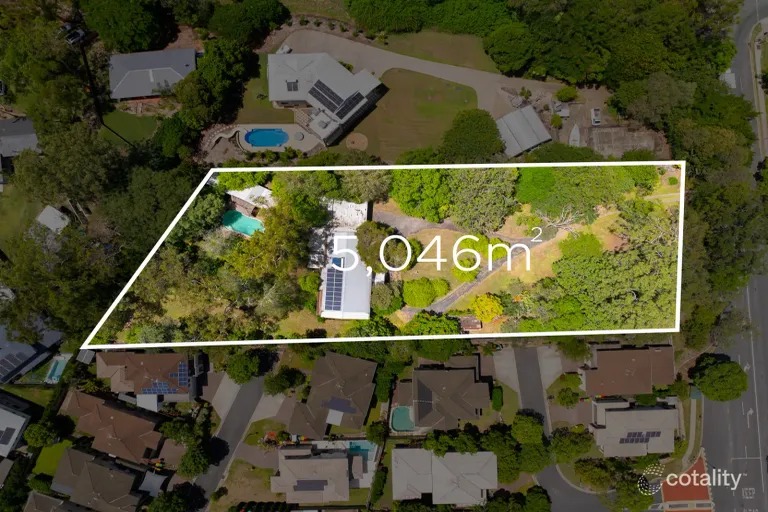
Previously, I analyzed three development sites that appeared to have potential but were actually limited in several key areas. This time, I want to discuss a contrasting example.
This plot of land in Belmont is indeed a rare and high-quality development site.
Its greatest value lies not only in its large land area, but also in its location within the Brisbane City Council, spanning over 5,000 square meters. This is especially true within the context of the area's planning policies. The reason is that many plots in the area, even those of considerable size, may not have easily zoning that supports actual subdivision or a workable development outcome. However, this plot is one of the few examples where such a development is truly feasible; its value comes not solely from its size, but from the fact that its planning path has the potential to be realized.
This is why such land is often extremely sought after on the market. Unfortunately, this Belmont site was quickly sold before the auction, without even a chance for further examination. At this point, it's pointless to check other details one by one, because discerning buyers have usually already identified their targets and acted swiftly.
The more site analyses I conduct, and the more I see projects that seem to have potential but are actually hampered by access, stormwater, servicing, terrain, or approval pathways, the clearer it becomes why truly high-quality development sites are so rare. Many sites seem to have a compelling story, but if the core implementation conditions aren't met, their potential remains merely theoretical. Conversely, truly valuable land often doesn't need much embellishment; as long as the planning logic is clear and the conditions are met, those in the know will naturally recognize it.
This again illustrates that a town planner and a general real estate agent can have vastly different perspectives on the same site. This is not only due to their different roles, but also because their knowledge base, analytical angles, and practical experience are fundamentally different. Real estate agents primarily focus on the market, price, product positioning, and how to help sellers enhance the property's attractiveness; town planners, on the other hand, will further examine zoning, access, stormwater, servicing, topography, council policy, approval pathways, and whether the overall development potential can truly be realized.
Therefore, for a development site, the most important thing is never how much potential can be stated on the surface, but whether the project's planning logic, technical conditions, and execution path are truly sound. Truly high-quality development sites are always rare and hard to come by.
To learn more about professional perspectives on town planning, site analysis, and development feasibility, please stay tuned. We will continue to share more practical analyses on development site assessment, planning systems, and investment risk management in the future.



 Chinese