

If you're considering buying a property in Australia, your first concern is budgeting and financing. This article will explain the pre-, mid-, and post-investment stages of purchasing real estate in Australia, from preparing to purchase to successfully completing the purchase, to the subsequent holding costs and other expenses. This article will provide a deeper understanding of the crucial financial planning and management aspects of Australian real estate, whether you're buying for personal use or investing!
 Contact your ANP real estate expert now to learn more and let ANP help you realize your dream of owning your ideal home in Australia!
* * *
WhatsApp: https://wa.link/viu9v7
Email: info@anp-au.com
Before buying
We recommend that you understand your budget and needs before purchasing real estate. For example, whether you need a loan, whether the purchase is for personal use or investment, whether you have Australian permanent residency or citizenship, or are an overseas person. These will affect the cost of purchase.
- Buyer's agent fees (if any)
Australian buyer's agents can charge commission or a flat fee, depending on the services provided. If commission-based, they typically charge the purchase price of the property, with the flat fee typically exceeding AUD$10,000.
We all understand whether the services of the buyer's agent meet your needs.
- Loan fees (if any)
Generally, local Australian banks do not charge fees for loan applications. However, some non-bank lenders, such as fund companies, may charge an application fee. These fees generally range from several hundred to one thousand Australian dollars, depending on the individual company's arrangements.
- FIRB
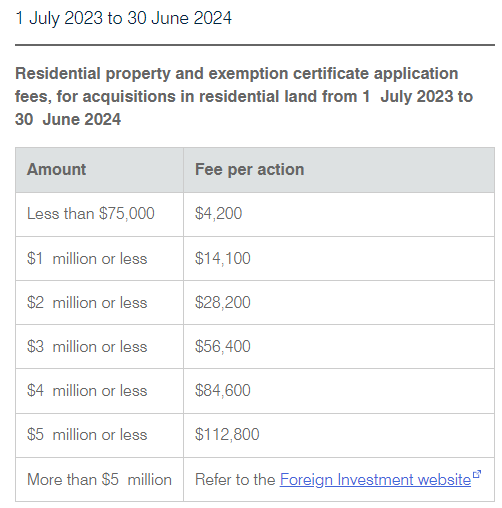
Before purchasing an Australian property, overseas buyers must apply to and obtain approval from the Foreign Investment Review Board (FIRB). This application also incurs a fee, which varies depending on the property transaction price. The latest FIRB fees are:
Purchasing, preparing for transaction
- House price
Once you've found a property you like, you'll need to arrange for the deposit, the remaining balance after deducting the loan, and the total purchase price. If you need a loan, the bank will calculate the mortgage amount based on your borrowing capacity and the value of the property being mortgaged. If the appraisal is lower than your initial offer, you'll need to cover the difference to secure the transaction.
Of course, the buyer's agent or lawyer will recommend including clauses in the contract to protect the buyer. For example, they can cancel the transaction and walk away unscathed in the event of an undervaluation, mortgage problems, or insufficient funds. We'll cover the home buying process and the legal aspects involved in it in another article.
- Building inspection fees
Before a property transaction closes, buyers can arrange for a professional building inspector to conduct a building and pest inspection. If the inspection report contains any issues, buyers can ask for a price reduction or even cancel the contract.
The cost is approximately AUD$400-500.
- Valuation Fees
If you need a loan, your lender will need to perform a valuation on your property. While the Big Four banks generally don't charge a valuation fee, other non-bank lenders may charge you a property valuation fee, which can be several hundred Australian dollars.
- Attorney Fees
Before signing the contract, and throughout the entire transaction process, you must be assisted and supervised by a lawyer who is familiar with real estate. The lawyer's fee varies depending on the lawyer's experience, the location, and type of property. The price ranges from AUD 1,500 to 2,000 per $.
- Stamp Duty and Foreign Buyer Additional Stamp Duty
Stamp duty is levied whenever personal and business assets are transferred. Property and land are considered assets, so governments levy stamp duty on the sale or transfer of real estate. The amount of stamp duty depends on the state where the property is located, the purchase price, and the property's intended use and type. Currently, stamp duty for Australian property purchases is determined by each state government, so the calculation varies widely, generally ranging from 3-5% of the property price. Furthermore, foreigners purchasing properties in most states are subject to an additional Foreign Buyer's Stamp Duty (7%-8%).
There is a stamp duty calculator on our company website, so you can estimate the stamp duty amount you need to pay: https://anp-au.com/stampduty/
- Water, electricity, municipal government, and property management fee adjustments
Since the closing date is determined by the contract, your lawyer will help you adjust the records of water, electricity, council fees, and property management fees to determine the respective amounts responsible by both the buyer and seller on the closing date. This fee is generally not high, around AUD 1,000 per $.
After buying
- Water, electricity, municipal government, property management fees
New homeowners are responsible for water, electricity, municipal fees, and property management fees. Depending on the location, these fees may be charged quarterly or semi-annually.
The level of council fees depends on the council where the property is located and the area of the property. For example, for a detached house with a land area of about 400 square meters under Brisbane Council, the quarterly council fees are about $380.
If the property you buy has community management, you will need to pay property management fees. This fee depends on the size and facilities of the community. For example, elevators, gyms, and swimming pools all require management. The more equipment there is, the higher the property management fee will be.
- Home insurance
Home insurance is mainly divided into two parts. The first part protects the building structure, and the second part protects the contents of the house.
If your property is used as an investment for rental purposes, you may want to consider purchasing homeowners insurance to protect you against losses in the event that the tenant fails to pay the rent on time during the rental period.
- Property rental management
If you rent out your property, the practices in Australia and Hong Kong are different. The following are common fees in Brisbane and Gold Coast for your reference.
Agency fee: one week's rent
Advertising fee: one week's rent
In Hong Kong, many real estate agents simply step away from the property once they've found a tenant. However, in Australia, the practice is different. Real estate agents continuously manage the property, collecting rent regularly, assessing market rents, arranging repairs, and communicating with landlords and tenants. Consequently, Australian real estate agents collect a 7-8% portion of the rent as a service fee.
- Repair/Maintenance
Generally, single-family homes require more maintenance than townhouses and apartments, such as regular termite inspections, pest control, and lawn mowing.
The common areas of townhouses and apartments are managed by the property management company, with expenses deducted from the management fee. Owners are generally only responsible for the interior areas.
- land tax
The way land tax is calculated varies from state to state and may also vary depending on the visa status of the holder.
The following is a summary of the land tax calculation methods in each state for your reference:







 Chinese