
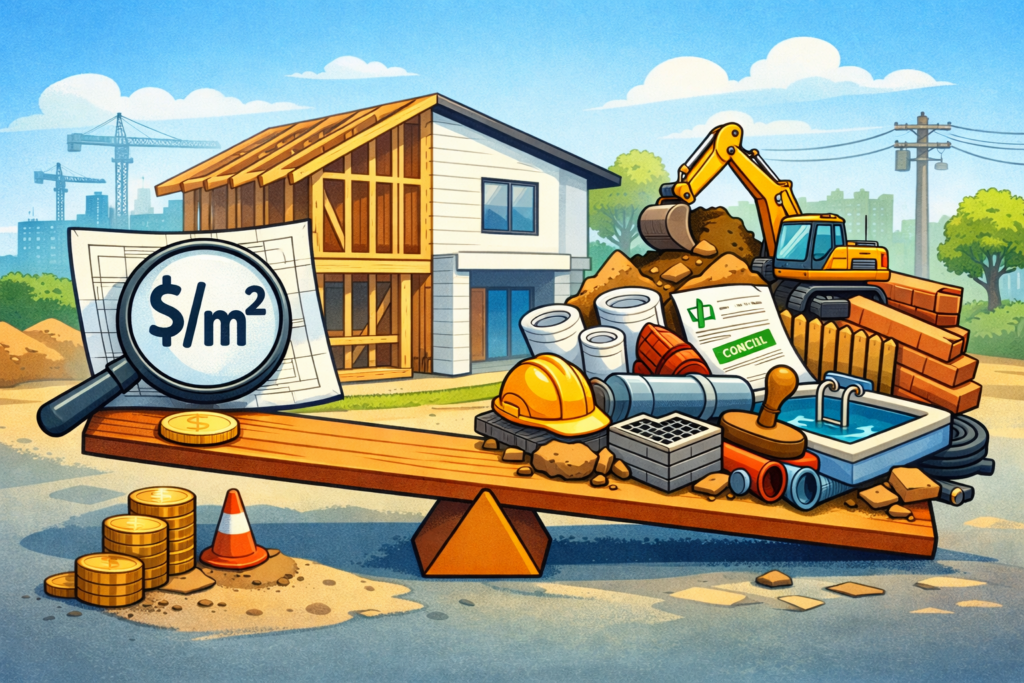
When it comes to building a house in Australia, many people's first focus is on the "cost per square meter" in the builder's quote. When they see a price, such as a certain number of Australian dollars per square meter, many people instinctively multiply this number by the building area to estimate the budget for the entire project.
However, in the actual construction process, this calculation method is usually just a starting point, not the final cost.
The reason is that the cost per square meter provided by the builder usually only reflects the construction cost of the main structure of the house. It can help buyers understand a general price level for construction, but it cannot fully reflect the total cost of the entire housing project. When the housing project actually begins, many other costs will gradually be added to the overall budget.
First, there are sitework-related costs. Every piece of land has different conditions, such as elevation, soil condition, drainage, whether retaining walls, excavation, or additional foundation treatment are needed. These factors directly affect the cost of building a house, and this expense is often not fully reflected in the initial cost per square meter.
Secondly, there are the costs of engineering and technical consultants. The building process typically involves multiple professionals, including structural engineers, surveyors, soil testers, and other engineering consultants. They need to provide technical analysis and design advice to ensure building safety and compliance with regulations. These professional services are essential to the entire building project but are often not included in the builder's base cost.
Furthermore, there are government approvals and related costs. In Australia, most residential building projects require building approval, and in some cases, development approval may also be required. In addition, different local governments have their own application fees and administrative costs, all of which are part of the housing budget.
In addition to the projects mentioned above, many other ancillary costs will gradually increase, such as service connections, building material upgrades, outdoor works, driveways, fencing, and landscaping. Often, even if the floor plans of two houses look similar, the final total cost can still differ by hundreds of thousands of Australian dollars due to these additional works.
Therefore, when planning a housing construction budget, the most important concept is not simply comparing the cost per square meter, but understanding the complete cost structure of the entire project. What really needs to be considered is the entire set of expenses, from initial design and consulting fees, main building costs, site works, government approvals, service connections to outdoor works.
For those planning to build their own home in Australia, it's easy to underestimate the overall budget if they only consider the builder's base price as the total cost. Conversely, understanding the building project from the perspective of "total cost" from the outset will lead to a more prudent approach in budget planning, design decisions, and builder selection.
In other words, the cost per square meter can be used as a reference, but it should never be considered the final answer for the entire housing project. What truly affects the cost of housing construction is the entire process from design to completion.
This article is for general informational purposes only and does not constitute legal, architectural, engineering, or investment advice; individual cases require consultation with professionals based on specific circumstances.




 Chinese