
When many people encounter custom build for the first time and hear that the initial design package costs tens of thousands of Australian dollars, their first reaction is usually: "Why do we have to pay so much before construction has even started, before the house has been built, and before the first brick has been laid?"
However, if you truly understand how custom builds work, you'll realize that what the builder is trying to say isn't "charge you more," but rather that a significant amount of real work is already underway before construction even begins, and this work itself requires specialized personnel, time, and resources. The typical process for custom homes in Australia isn't about giving a random quote and then gradually making changes; it involves stages like pre-design, design refinement, construction drawings, engineering documentation, and quotation compilation. Only then does the builder have a solid foundation to move the project forward.
The biggest difference between custom builds and mass-market builds is that the latter often have predetermined floor plans, structures, and material systems, with clients mostly making minor adjustments within a limited framework. Custom builds, however, are truly tailored from scratch, based on your land, your requirements, and your desired lifestyle. Whether the site is sloping, which way the view faces, how setbacks are calculated, how space is allocated, how the driveway is located, and how the internal circulation is arranged—all these must be broken down step by step. This also explains why the design process for a custom home itself requires progressing from briefs, site constraints, and concept design all the way to construction documentation, rather than being completed using a set of ready-made plans.
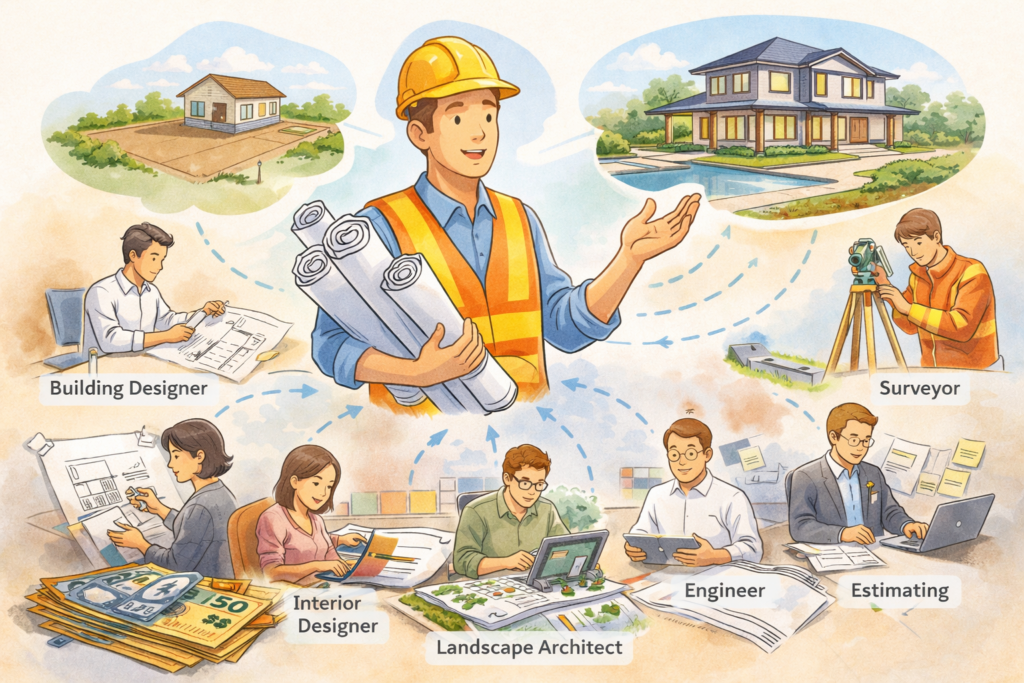
To put it more practically, the upfront costs mentioned by builders go far beyond simply "drawing plans." For a custom home to reach a stage where it's ready for construction, can be quoted, and can obtain approvals, it typically involves building designers, engineering consultants, surveys, soil testing, material selection, cost estimating, and even repeated revisions and coordination between different disciplines. Queensland's official guidelines are also clear: most residential projects require building approval before construction, and certification involves reviewing and inspecting plans and construction work. In other words, the documentation and technical preparations before formal construction are prerequisites for the project to come to fruition.
Another key point the builder is trying to make, and one that's even more noteworthy, is that if you don't use an integrated package and instead hire building designers, interior designers, landscape architects, surveyors, and structural engineers separately, and then handle the overall coordination yourself, it might not be cheaper in theory, and in practice, it often costs more. The reason isn't that individual professionals are particularly expensive, but rather that you have to bear the cost of coordination yourself. Each consultant has their own deliverables and pace; if one part is modified, others may need to be adjusted accordingly. These back-and-forth revisions themselves take time and manpower. This is why many custom builders package design coordination, consultation, working drawings, site information, and estimating into a preliminary package—because they're selling not just design deliverables, but also the ability to connect the entire preliminary process.
From a cost perspective, the rationale behind this upfront fee lies in its ability to gradually transform "uncertainty" into "clarity of constructability." At the project's inception, you only have an idea; after the initial design phase, you begin to understand site limitations, design direction, structural requirements, foundation conditions, potential materials, and how the builder should estimate costs. Without this initial preparation, even if someone is willing to provide a building price later, that figure will often be a rough estimate, not a reliable one.
Moreover, the cost structure of a custom build is inherently more complex than that of a project home. Recent Australian building cost data generally indicate that the cost per square meter for a custom or high-specification residence is usually higher than that of a standard builder, due to greater design complexity, material selection, site conditions, and the need for professional collaboration. This also illustrates that if the later stages of construction are already complex, the initial preparation cannot be entirely free, nor can everything be explained clearly in just one or two meetings.
Therefore, while the builder may say this upfront fee is unfair, it's actually reasonable. The key point isn't simply that "tens of thousands of dollars is normal," but rather that custom building is never a model where the first half of the work can be completed with a free quote. If you want a truly feasible, constructible, and quotable custom home project, then design, coordination, technical preparation, and cost accounting are all real entry costs.
In other words, this money isn't an extra luxury, but a necessary step in turning an abstract idea into a real project. For sophisticated buyers, the real question isn't "Why do we have to spend money before construction even starts?", but rather "If we don't do this work properly upfront, will the building price and construction risks become even more unstable later on?"
This article is for general informational purposes only and does not constitute legal, architectural, engineering, tax, or investment advice; individual cases require consultation with professionals based on specific circumstances.



 Chinese