

According to the latest data from CoreLogic, the national House Value Index (HVI) recorded a 1.6% increase in the first quarter of 2024, with the average property value increasing by approximately A$12,000, marking the 14th consecutive month of growth. Following a 7.5% decline between April 2022 and January 2023, the national HVI has risen by a cumulative 10.2%, or approximately A$71,832, reaching new highs every month since November last year.
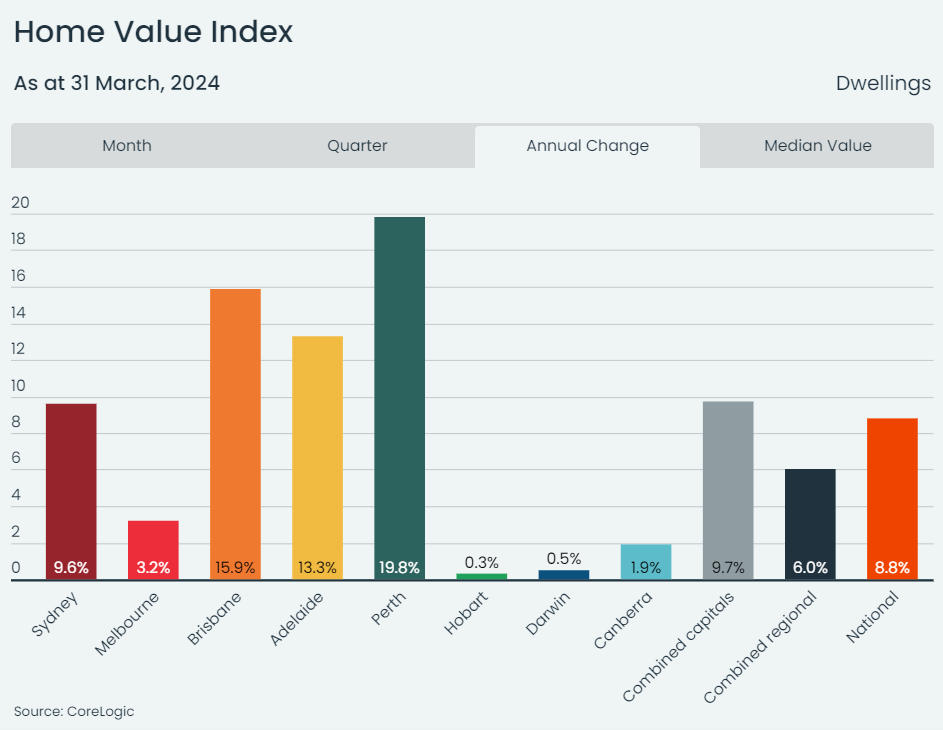
Dwelling values rose in all capital cities except Darwin (down 0.2%) over the past month, although CoreLogic research director Tim Lawless noted that monthly growth still showed variation.
The performance of the capital city housing market is divergent, with Brisbane continuing to rise strongly and Melbourne being the only city to experience a decline.
"House price performance varied widely, with Perth leading the way with growth of 1.9%, followed by Adelaide at 1.4% and Brisbane at 1.1%. The other capital cities saw lower growth, with Melbourne being the only capital city to record a fall over the quarter, down 0.2%."
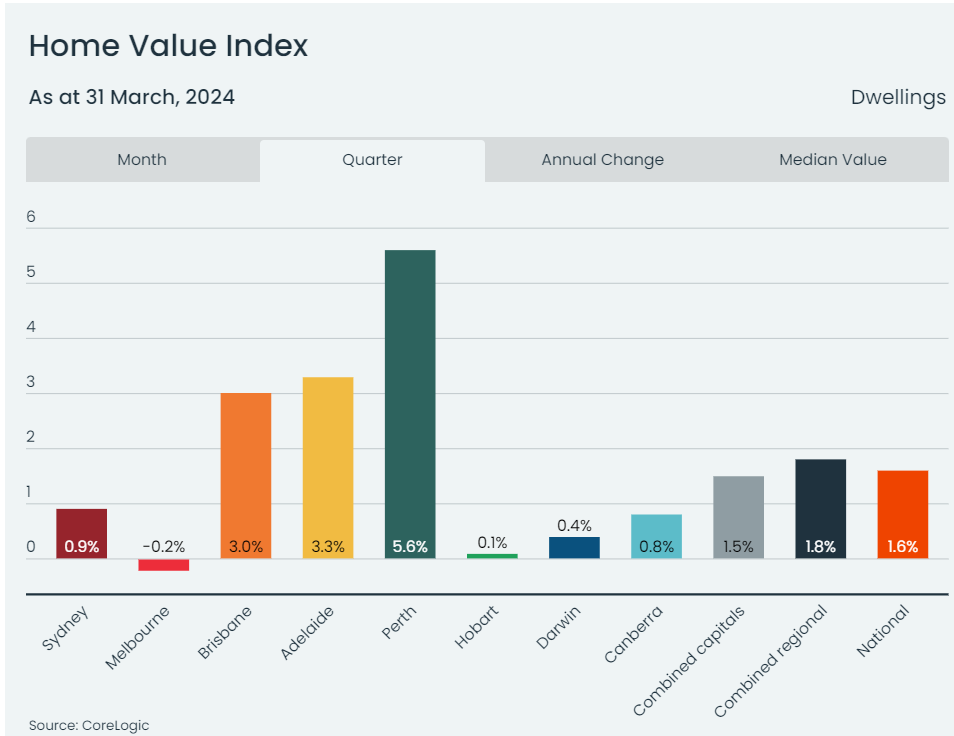
Quarterly national growth accelerated to 1.6% in the first quarter of this year, compared to 1.4% in the fourth quarter of last year. While house prices are rising faster than at the end of last year, the quarterly growth trend has halved compared to mid-year, when house values grew by 3.3% quarterly.
"Rising interest rates, cost of living pressures and worsening housing affordability have weighed on the housing market since the middle of last year," Lawless said. "However, the low supply of homes relative to demand has continued to drive up home values despite these headwinds."
“House price growth and decline vary across regions, which can be explained by significant differences in affordability, demand pressures from population growth, and a lack of housing supply. Looking at Perth’s rapid growth, despite such rapid price increases, property affordability remains relatively high in Perth compared to other larger capital cities. Housing supply is in short supply, and demand remains high due to well-above-average interstate and overseas migration.”
Western Australia is benefiting from strong international and interstate migration.
Last month's Australian Bureau of Statistics population data revealed some extremes in interstate and overseas migration trends in Western Australia. Net overseas migration to Western Australia reached 18,122 in the September quarter, well above the 10-year quarterly average of 4,639, a trend seen in most states. Unlike some states, net interstate migration was significantly higher than the 10-year average of -96, reaching 2,237 per quarter. This extreme shift in demographic trends has created a significant positive demand shock for Western Australian housing.
After being driven by the more expensive end of the market for much of last year, the strongest growth has shifted to the more affordable end of the market in most capital city markets. Across the combined capital cities, dwelling values in the more affordable end of the market grew by 3.11t/3t in the first quarter of this year, compared to just 0.71t/3t for the more expensive end of the market. This trend of stronger conditions in the more affordable end of the market has been seen in every major capital city.
"With housing affordability becoming more challenging and borrowing capacity lower than a year ago, it's not surprising to see demand skewed towards the lower to mid-price range," Mr Lawless said.
Regional Victoria was the only state to experience a fall in property prices.
Regional property markets also recorded price growth, showing a mixed bag of gains and losses, similar to their capital city counterparts. The only region to experience a fall was Victoria, where values fell by 0.3% in the first quarter, making it the only broad regional region to record a decline so far.
Home sales in the first quarter of this year are estimated to be 9.51Tpa/3T higher than the same period last year, although this is from a relatively low base compared to a year ago, when the housing market was recovering from a downturn at the beginning of last year. Home sales are estimated to be 3.71Tpa/3T higher than the average over the past decade.



 Chinese