
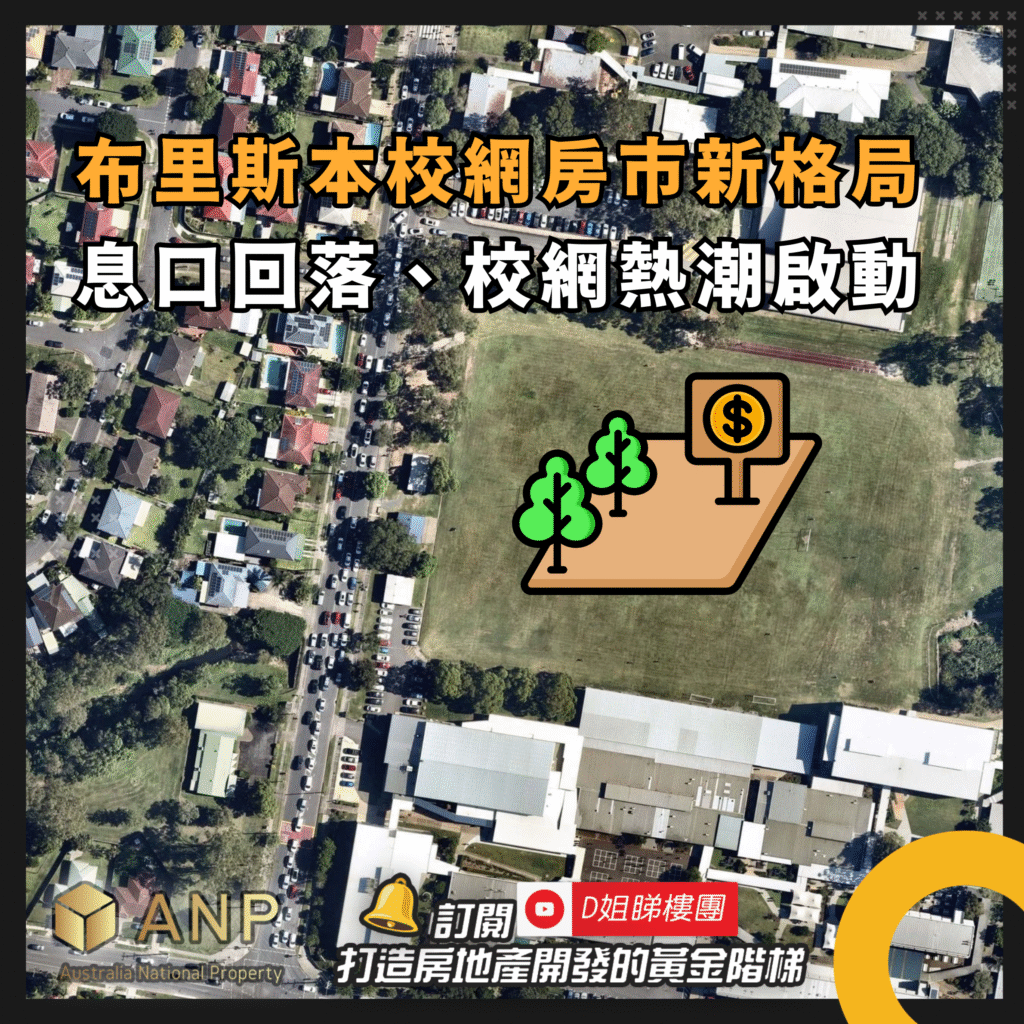
Cooling inflation and falling interest rates inject slight upward momentum into the property market
The Reserve Bank of Australia (RBA) cut interest rates again last week, lowering the cash rate target by 25 basis points to 3.60%. With inflation gradually falling back to the target range of 2-3%, the market generally expects monetary policy to have entered a gradual easing cycle. This easing of interest rate pressures, increased household borrowing capacity, and renewed demand in the property market are fueling demand for properties in Brisbane's school zones.
Contents Overview
ToggleHousing prices continue to rise, with units outperforming houses
According to July data, Brisbane's overall house prices rose by 0.71t/3t month-over-month, 2.01t/3t quarter-over-quarter, and 7.01t/3t year-over-year, reaching a median price of approximately AUD 926,000. The median house price has surpassed AUD 1 million, while units have seen even stronger annual growth of over 10%, indicating a shift in demand driven by affordability towards the unit market. Since mid-2020, Brisbane's house prices have increased by a cumulative 751t/3t, one of the strongest performances nationwide.
The rental market also reflects tight demand. Brisbane's current rental vacancy rate is only around 0.91 per 3T, with fewer than 3,100 properties available for rent. The supply squeeze is even more pronounced in sought-after school districts, driving both owner-occupier and investor demand.
School network becomes the focus, with premium and risks coexisting
In Brisbane, areas within the catchment area of prestigious public schools have long been a top choice for families. The three most sought-after school zones are Brisbane State High School, Mansfield State High School, and Indooroopilly State High School. Buyers are often willing to pay a premium to ensure their children attend their chosen schools. Market estimates indicate that units within the Brisbane State High catchment area often command a premium of 51 to 101 TWD per square meter compared to surrounding areas. Competition for detached houses in the Mansfield school zone is even more intense, forcing some families to pay hundreds of thousands of dollars in additional costs.
However, research also shows that while properties in school zones offer a defensive advantage, their long-term appreciation rates may not necessarily be higher than those in other areas. For example, in Sydney and Melbourne, while many properties in school zones command prices exceeding 30% above their neighboring areas, their growth over the past 15 years has lagged behind surrounding markets. Properties in Brisbane's school zones should also be wary of the same situation.
Checklist: Three things to ask when investing in a school-based online storage service
First, school district boundaries are subject to change, so buyers must verify their address is still within the school district using a map from the Education Bureau. Second, many popular schools have enrollment management programs (EMPs), requiring parents to provide proof of residency. Failure to do so may result in a potential loss of admission even if the property is in the school district. Third, investors should compare the long-term appreciation of properties within and outside the school district, avoiding relying solely on the "school district" halo while ignoring factors such as infrastructure, transportation, and supply.
Interest rates and market cycles combined with household demand
With the Reserve Bank of Australia (RBA) beginning to cut interest rates, market confidence is gradually recovering. For Hong Kong buyers seeking long-term residency or to fund their children's education, properties in the Brisbane school zone offer both residential value and value preservation. While they may command a significant premium in the short term, these properties are expected to maintain strong demand amidst limited supply and tight rental conditions.
| School network | Median property price | rental yield | Increase in the past five years | Investment/self-use focus |
|---|---|---|---|---|
| Brisbane State High School (BSHS) | about AU$950,000(mainly units) | about 4.2% | +72% | The city center school network has a large supply of units, extremely strong rental demand, and fierce competition. It is suitable for families pursuing educational resources and stable rental returns. |
| Mansfield State High School (MSHS) | about AU$1,150,000(Mainly detached houses) | about 3.6% | +68% | It is mainly for family residence and is one of the most competitive. Buyers generally have to pay a premium. It is suitable for long-term self-residence and education needs. |
| Indooroopilly State High School (ISHS) | about AU$1,050,000(Houses and units mixed) | about 3.8% | +70% | The West District has convenient transportation, is close to universities and scientific research parks, and has demand from both international students and professional families. It is an area that focuses on both mid- to high-end self-residence and investment. |
ANP professional opinion: Give equal weight to education and investment
Investing in school-network properties is an art form that balances education and finances. The ANP team, combining expertise in real estate consulting and urban planning, can assist buyers in analyzing school network distribution, long-term asset appreciation potential, and legal and tax implications. With interest rates declining, Brisbane's school-network properties are poised to become a renewed investment hotspot, making them ideal for Hong Kong families and investors considering both education and investment opportunities.






 Chinese