
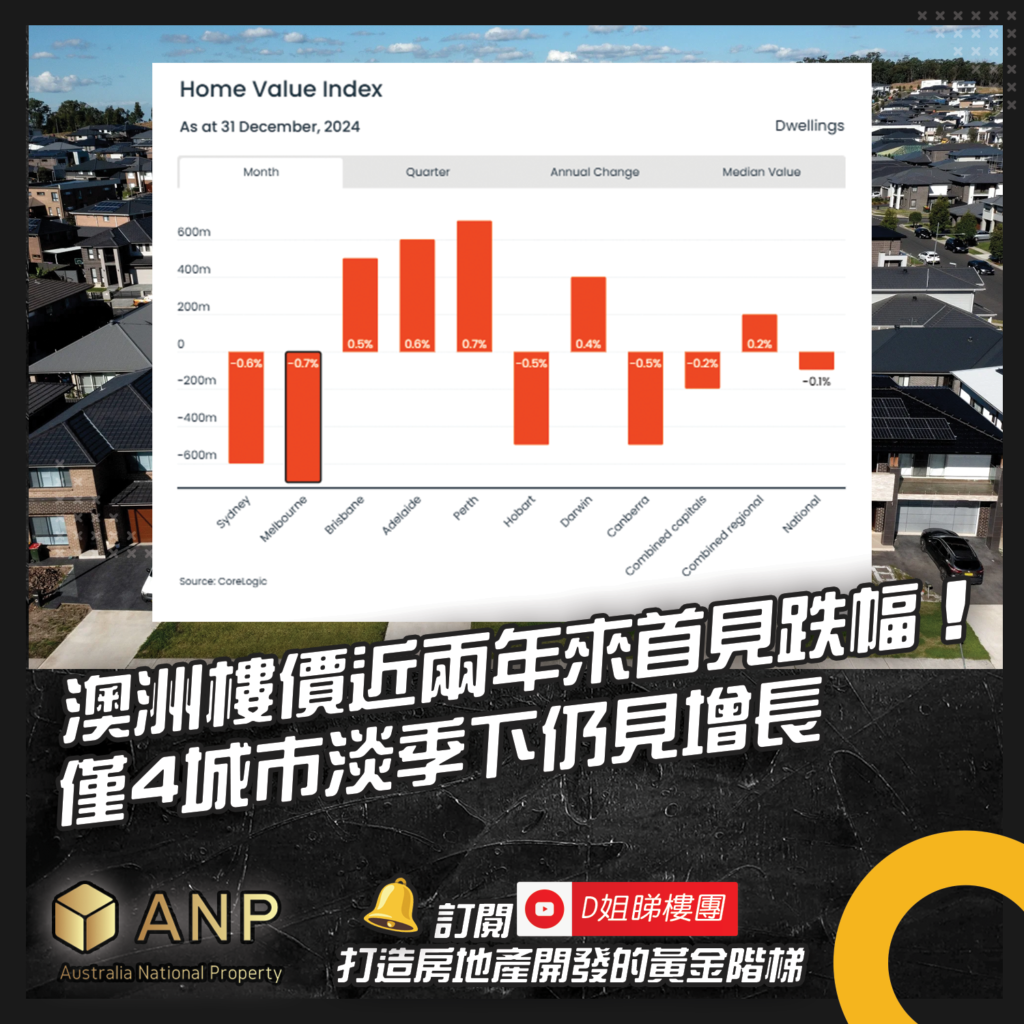
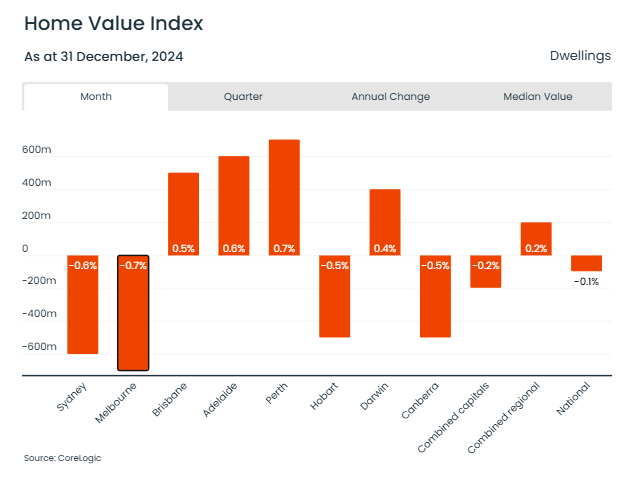
While Australia's property market has consistently performed strongly, attracting global investors, last month's CoreLogic Home Value Index (HVI) showed a monthly decline of 0.11% in national home prices in December 2024, ending nearly two years of consecutive growth. This marked the first national decline (-0.11%) since the period of strong growth from February 2023 to October 2024, marking a new phase for the Australian property market. Analysts point out that in addition to factors such as high interest rates and increased supply, the Christmas holiday off-season may also have impacted the property market.
The monthly drop in property prices is not surprising
CoreLogic research director Tim Lawless pointed out that the decline in house prices in December was in line with market expectations, reflecting that the Australian property market has gradually caught up with market dynamics.
"In the second half of this year, the property market continued to slow, mainly due to buyers facing high housing price pressures and a decline in demand due to increased market supply."
——Tim Lawless
Data shows that national house prices recorded a 4.1% increase in the first half of 2024, but the increase in the second half was only 0.7%. Between July and December, five of the eight major capital cities recorded a decline in house prices, with only Brisbane, Adelaide and Perth continuing to rise.
The impact of the Christmas off-season
The Christmas and New Year holidays at the end of each year are usually the peak of the Australian property market.Traditional off-seasonIn December, most buyers and sellers focus on holiday activities, and market transaction volume is usually low. Coupled with family travel and holiday atmosphere, the real estate market transaction activities are further reduced.
Low transaction volumes can exacerbate market volatility, making property prices susceptible to shifts in supply and demand. CoreLogic noted that the December price drop was likely due to a combination of seasonal factors and market dynamics.
2024 Full Year Review: Mid-sized Cities Show Strong Growth
Despite the year-end drop, national house prices are still expected to rise by $4.9% in 2024, with the median house price increasing by about $38,000.
Recorded a full-year decline:
- Melbourne:-3.0%
- Hobart:-0.6%
- Canberra (ACT):-0.4%
- Eye-catching growth:
- Perth:+19.1%
- Adelaide:+13.1%
- Brisbane:+11.2%
While medium-sized cities have seen significant growth, the peak has already passed. For example, Perth's full-year growth reached 24.71 TP3T in July, while Adelaide reached 14.61 TP3T in August and Brisbane reached 17.01 TP3T in April.
Adelaide leaps to the top of quarterly growth charts
Last quarter, Adelaide replaced Perth as the fastest growing city, with house prices rising by 2.1% quarter-on-quarter; Perth and Brisbane recorded increases of 1.9% and 1.3% respectively.
Mr Lawless said Adelaide's growth was mainly due to an extreme shortage of supply, with the number of properties available for sale in mid-December 34% below the five-year average. In contrast, Perth's supply has increased, increasing buyers' choices and reducing their urgency to buy, leading to slower growth.
Lower-priced properties are popular
The data shows the most affordable housing markets will see the fastest growth through 2024:
- Low-price market: National growth of 9.8%
- High-priced market: Only increased by 1.5%
Lawless explained that due to reduced affordability and reduced borrowing capacity, buyers are gravitating towards lower-priced markets, leading to stronger growth in these areas.
Regional markets outperform capital cities
Regional property markets outperformed capital cities throughout the year:
- National property price growth:+6.0%
- Capital city property price growth:+4.5%
Western Australia (+16.1%), South Australia (+12.5%) and Queensland (+10.5%) led the gains, but Victoria (-2.7%) and the Northern Territory (-4.7%) recorded declines.
Conclusion: What is the outlook for the Australian property market in 2025?
Although property prices slowed somewhat at the end of the year due to the Christmas off-season and market pressures, they maintained solid growth throughout the year. Looking ahead, Australia's property market will continue to be influenced by high interest rates, cost of living pressures, and limited affordability. While the Christmas off-season may offer more flexibility for negotiation, the overall market still requires careful observation.
# Australian Property Market # Property Price Changes # Immigrant Life # Hong Kong Immigration






 Chinese