
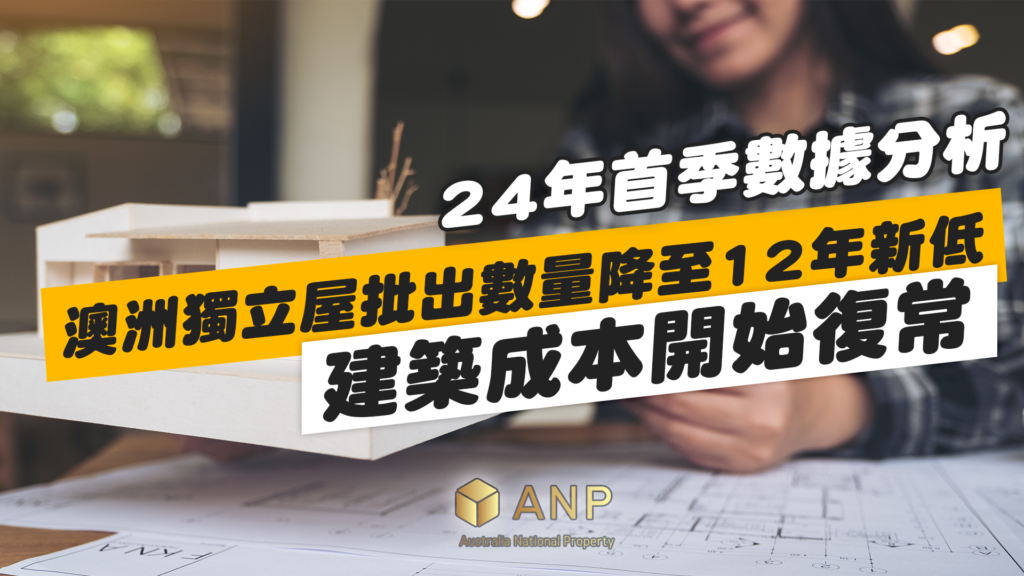
The latest data from CoreLogic's Construction Cost Index (CCCI) shows that national construction cost growth has stabilized in the first quarter of 2024. While the number of single-family home development permits approved by the government has fallen to a 12-year low, the construction cost index increased by only 0.8% in the first quarter, the same as the previous quarter.
This quarter's stable performance has slowed the CCCI's annual growth rate to 2.8%, the lowest annual increase since March 2007 and well below the average of 4.0% in the decade before the pandemic.
Building material costs remain high Expectations remain stable
CoreLogic economist Kaytlin Ezzy said that while national construction cost growth has slowed from its peak during the pandemic, current prices remain high. "The large fluctuations in building material costs over the past few years have stabilized and are now within a normal range," Ms. Ezzy said, adding that current construction costs are 27.61T/T higher than at the start of the pandemic, which could put significant pressure on builders.
Ms. Ezzy expects construction costs to remain within normal ranges over the next year. “With national residential development consents expected to remain well below average in 2023 and into 2024, this will help contain construction cost increases,” she explained.
The construction market remains busy with over 250,000 unfinished homes
Australian Bureau of Statistics data showed house approvals fell to their lowest level since June 2012 in January at 7,701, while February's figure remained 135,131 below the decade average. Despite this, Ms Ezzy noted the building pipeline showed about 255,000 dwellings approved but not yet completed, which was expected to keep the construction industry busy throughout 2024.
Construction costs by state
The change in construction costs was broadly consistent across the states over the quarter, with Queensland and South Australia both recording an acceleration in cost growth, with both rising by 0.7% in March. Meanwhile, growth eased in New South Wales and Victoria, both increasing by 0.9%, while the quarterly change in Western Australia remained stable (0.7%).
The CCCI in New South Wales rose by 0.91 TP3T, down 10 basis points from the 1.01 TP3T increase in the December quarter of the previous quarter, bringing the latest increase in line with the average level of the decade before the pandemic. Over the past 12 months to March, the annual CCCI growth in New South Wales was 3.11 TP3T, the same as the previous 12 months to December.
Victoria's CCCI rose by 0.91 TP3T over the quarter, down 30 basis points from the 1.11 TP3T increase in the December quarter. Despite the slight slowdown over the quarter, Victoria's CCCI is projected to rise by 3.11 TP3T annually in the 2024-2025 period, up from an annual increase of 2.91 TP3T in the year to December, which was the lowest annual increase since December 2016 (2.61 TP3T).
Queensland recorded a 0.71tpa rise in construction costs in the March quarter, compared to a marginal increase of 0.11tpa in the December quarter. Annually, Queensland's CCCI increased by 2.31tpa, down from 2.81tpa in the previous 12 months to December. This is the lowest annual increase in construction costs in Queensland in nearly 14 years.
Western Australia's construction costs rose by 0.7% in the quarter, in line with the increase in the fourth quarter of 2023. On an annual basis, Western Australia's CCCI increased by 2.1%, the lowest annual increase in construction costs in nearly seven years.
South Australia's CCCI increased by 0.71 TP3T, up from 0.51 TP3T in the fourth quarter of 2023. This brought the annual increase in construction costs in South Australia to 2.61 TP3T over the past year.
#Australian real estate #Australian land and house purchase #Australian real estate #Australian property market #Australian developers #Australian planning #Australian economy





 Chinese